
Programmatic Ad Operations Services for Publishers
Programmatic advertising runs on automation, but revenue stability depends on operations. Many publishers invest in new demand partners, header bidding integrations, and revenue tools. Yet performance often remains inconsistent. The reason is simple: without disciplined ad operations management, even strong demand cannot perform at its full potential.
Our programmatic ad operations services are part of our publisher revenue architecture consulting, focused on building a clean, controlled, and transparent monetization structure. We help publishers manage execution, reduce revenue leakage, and maintain ad quality across their stack.

What Are Programmatic Ad Operations?
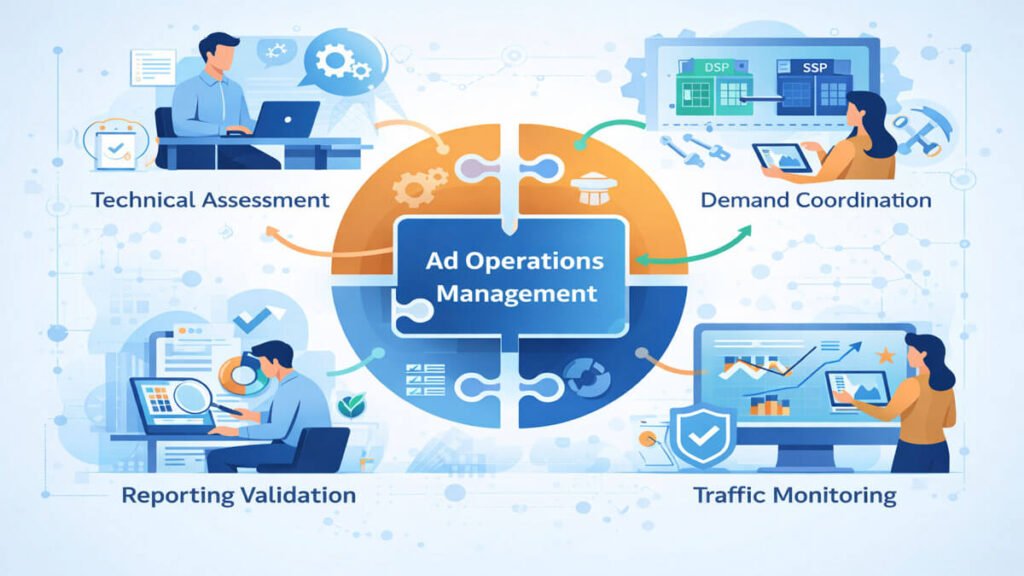
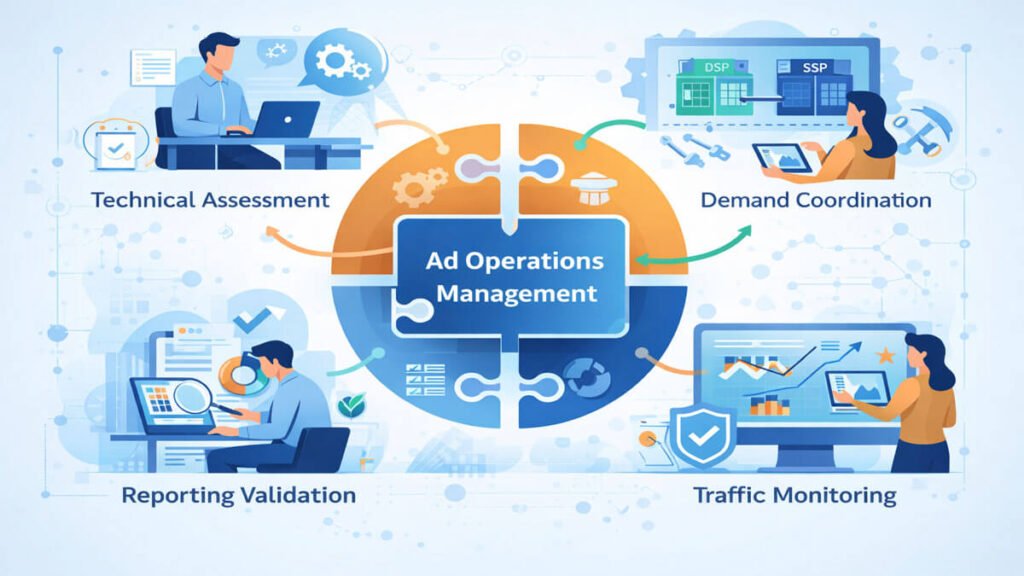
Programmatic ad operations refer to the day-to-day technical management of a publisher’s monetization infrastructure. This includes ad server management, auction alignment, demand partner coordination, reporting validation, and traffic monitoring.
When ad operations lack structure, publishers may experience:
- Conflicting auctions
- Floor price instability
- Inconsistent fill rates
- Reporting discrepancies
- Brand safety concerns
- Exposure to invalid traffic
Strong ad ops management ensures that all components of the programmatic ecosystem work together in a coordinated system.
Our Approach to Ad Operations Management
We treat ad operations as a continuous process, not a one-time setup.
1. Technical Assessment
An independent monetization systems evaluation forms our starting point, where we analyze ad server setup, header bidding configuration, and demand integrations to identify inefficiencies. The goal is to identify the inefficiencies, the duplication of work, and the revenue blockers.
2. Structural Cleanup and Alignment
After identifying friction points, we streamline your monetization framework. This may involve:
- Reorganizing line item hierarchies
- Refining floor pricing logic
- Executing direct supply path consolidation measures to eliminate duplication and improve auction clarity.
- We may also implement multi-bidder auction configuration improvements to strengthen bid competition and execution flow.
- Standardizing reporting structures
A simplified structure often leads to improved auction clarity and more stable performance.
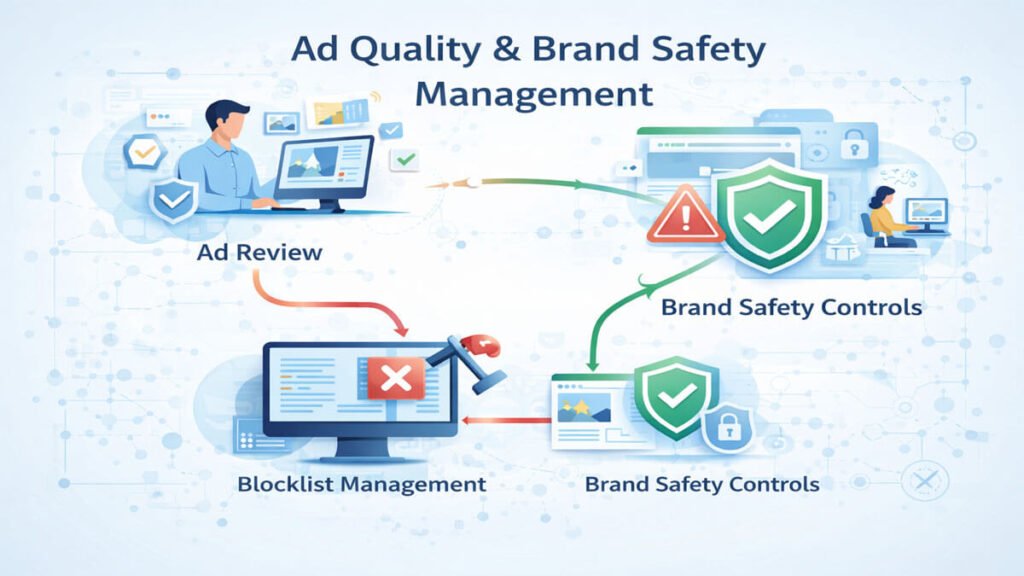
3. Ad Quality and Brand Safety Management
Ad quality monitoring protects both user experience and advertiser trust. We review creative standards, refine blocklists, and implement brand safety controls to reduce risk. Clean ad delivery improves long-term partnerships and protects your reputation.
4. Invalid Traffic (IVT) Monitoring and Fraud Prevention
Invalid traffic can damage revenue and strain demand relationships. We conduct traffic pattern analysis, monitor suspicious activity, and implement preventative measures to reduce IVT exposure. Traffic quality control helps preserve platform credibility and ensures sustainable growth.
5. Ongoing Operational Oversight
Programmatic environments change constantly. Demand sources evolve, traffic patterns shift, and policies update. Continuous monitoring helps maintain performance stability over time.
Who Benefits from Programmatic Ad Operations Services?
Our ad operations consulting and management services are ideal for:
- Publishers scaling beyond basic monetization setups
- Media networks managing multiple demand partners
- Businesses facing revenue volatility
- Teams without dedicated in-house ad ops resources
If revenue fluctuates without a clear reason, operational inefficiencies are often the underlying cause.
What Results Can Publishers Expect?
Well-managed programmatic ad operations can lead to:
More consistent fill rates
- Improved auction transparency
- Well-managed ad operations can reduce revenue leakage through systematic advertising yield refinement and better auction alignment.
- Lower invalid traffic risk
- Better reporting clarity
- Stronger demand partner confidence
Operational discipline creates the foundation for sustainable monetization growth.
Why Operational Structure Matters in Programmatic Advertising
However, it’s also important to note that new demand does not always mean new revenue. In fact, it’s possible that new demand simply means new complexity. This is unless ad servers are effectively managed, as well as ad ops processes, to ensure that competition does not create a negative effect.
Structured ad operations for programmatic ads create order out of complexity. This operational discipline reflects the publisher monetization philosophy developed by Tanvi Singh, guiding every infrastructure decision.This is because when ad infrastructure is stable, revenue optimization is also possible.
Get in touch with us
Contact: +91-9899068784
Email: contact@adyieldlabs.com
FAQs
What are programmatic operations?
Programmatic operations are the management of automated buying and selling activities in digital advertising. On the publisher’s end, this entails ad server configuration, auction configuration, demand configuration, as well as performance monitoring.
What is the difference between programmatic and ad operations?
Programmatic is the automated buying and selling of digital ad inventory. Ad operations is the technical execution and management of the programmatic model. To put it simply, programmatic is the ad tech stack, and ad operations is the oil that makes the machine run.
What is brand safety in programmatic advertising?
Brand safety in the context of programmatic advertising is the process of ensuring that advertisements do not run alongside unsafe, inappropriate, or non-compliant content. This is achieved through monitoring, optimization of blocklists, and compliance standards.
What is invalid traffic (IVT) in advertising?
Invalid traffic, or IVT, refers to ad impressions or clicks that were not generated by users but by bots or automated scripts. IVT monitoring and prevention is essential in ensuring revenue integrity and trust among demand partners.