
Programmatic Advertising Agency for Publishers
A programmatic advertising agency is an organization that helps the publisher comprehend and enhance their advertising revenue-generating systems. As an advertising program agency at AdYield Labs, we specialize in the programmatic advertising space on the publisher side. Our mission is quite simple: we believe that it’s essential to assist the publisher in creating an ad system that’s reliable, understandable, and monetizes well over time.
Programmatic advertising has become the core of digital monetization. However, the ad stacks of many publishers tend to become increasingly intricate and difficult to comprehend. Floor prices are adjusted, new demand partners are added, and auction behavior changes in ways that are not always obvious. A programmatic advertising agency helps publishers step back from constant adjustments and instead understand how their monetization system actually behaves.
At AdYield Labs, our work begins with clarity. Prior to making any changes, we conduct a structured review of how the existing infrastructure works, how demand competition reacts to price changes, and where inefficiencies may exist through our programmatic consulting for publishers. It helps a programmatic advertising agency ensure that decisions are made for the publisher that help them perform optimally without creating instability.
Programmatic Advertising Services
Our programmatic advertising services focus on improving how publisher monetization systems perform in practice. Many publishers already have a functioning programmatic setup, but small inefficiencies within the system can quietly reduce revenue over time.
Through our programmatic advertising services, we examine the structure of inventory, demand partner contribution, auction competition, and pricing logic. This process often reveals opportunities to improve yield from existing impressions through structured programmatic yield optimization services rather than relying on increased ad density.
Because monetization systems are interconnected, improvements are implemented gradually. These programmatic advertising services allow publishers to strengthen their infrastructure while maintaining a healthy balance between revenue, operational stability, and user experience.
Developing a Clear Programmatic Advertising Strategy
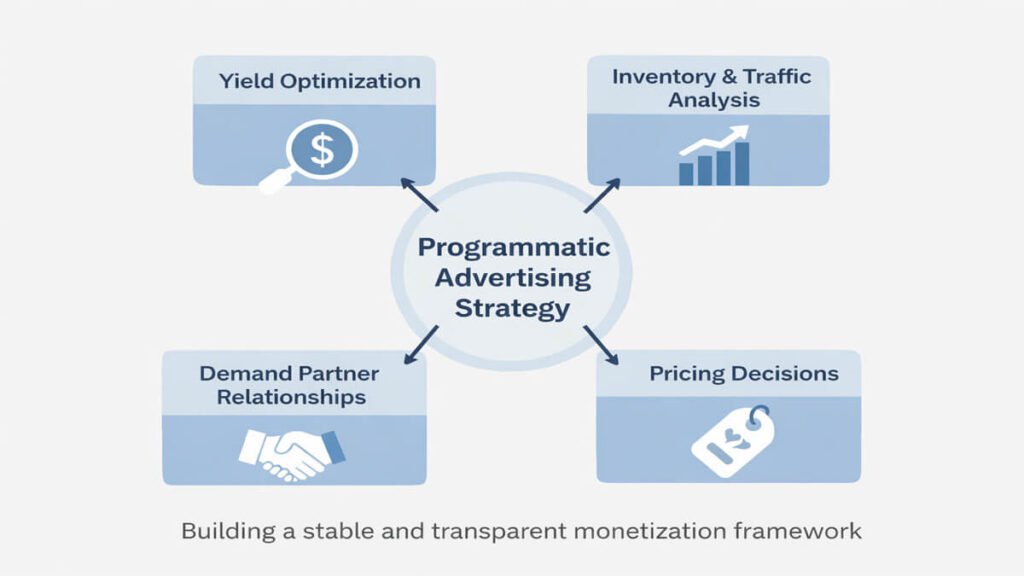
Every publisher environment behaves differently. Audience geography, content formats, device mix, and advertiser demand all influence revenue patterns. For this reason, a strong programmatic advertising strategy must reflect the unique characteristics of a publisher’s inventory.
AdYield Labs helps publishers build a programmatic advertising strategy that focuses on long-term system stability rather than short-term fluctuations. Rather than constant reactive changes, the objective is to develop a system that has predictable auction activity and understands changes in revenue. A well-thought-out programmatic advertising strategy enables publishers to better assess their demand partners’ needs, refine pricing models, and sustain a healthy level of competition within auctions. Ultimately, this results in a more stable revenue curve.
Working with Modern Programmatic Advertising Platforms
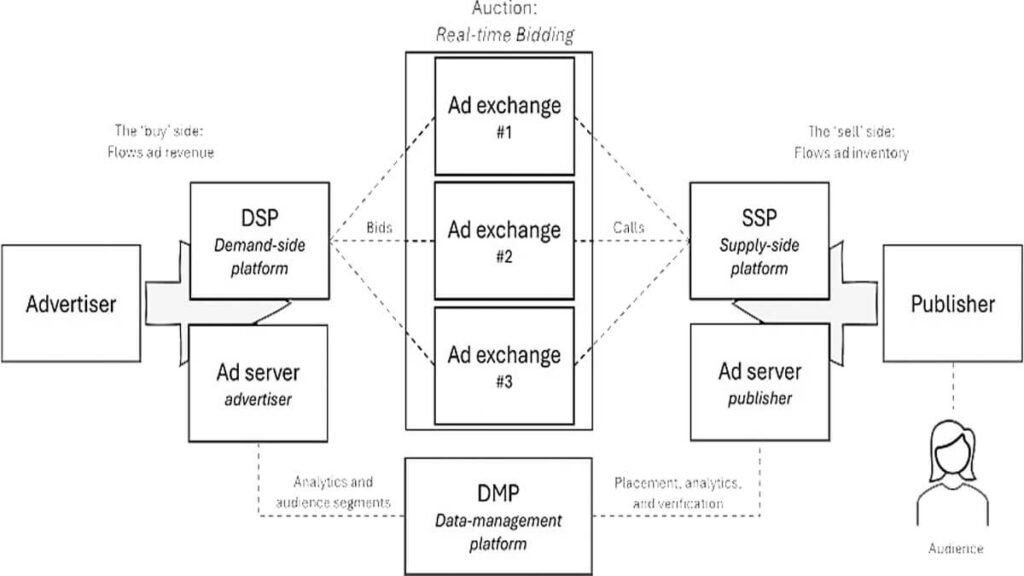
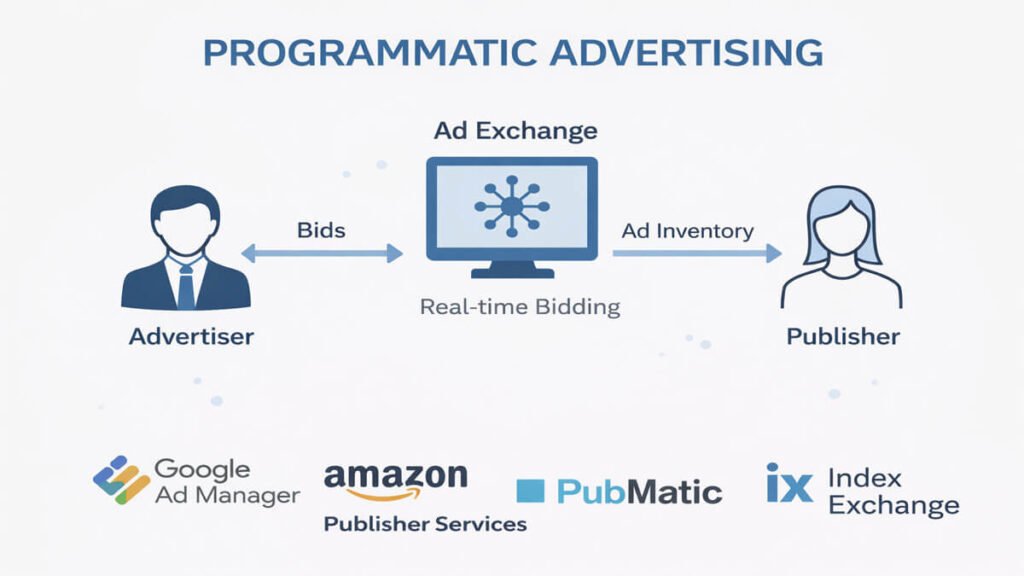
Today’s monetization infrastructure depends on several interconnected programmatic advertising platforms operating together within a publisher’s ad stack. These platforms enable automated auctions where advertisers compete for impressions in real time, often supported by well-implemented header bidding infrastructure for publishers.
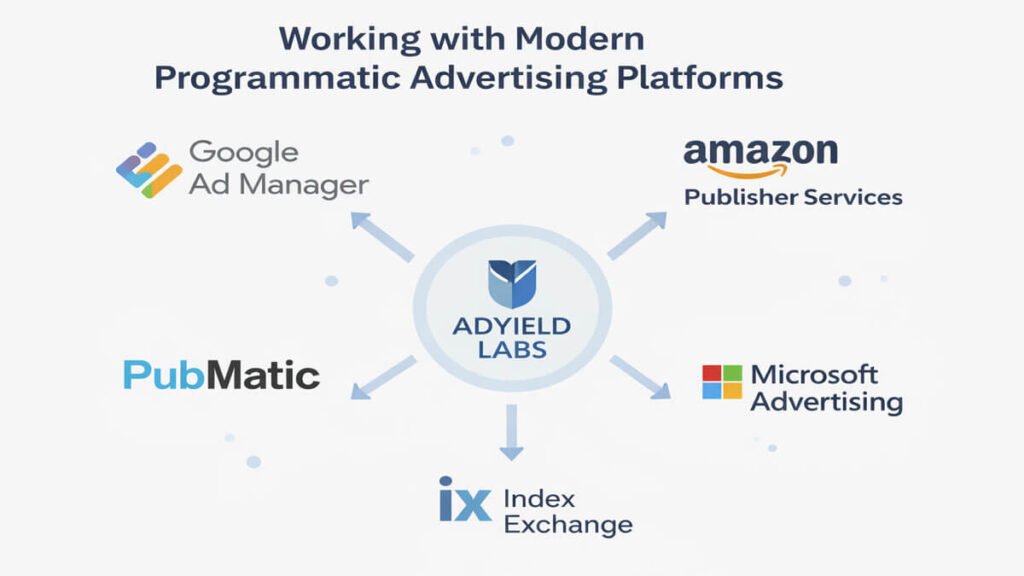
As a programmatic advertising agency, AdYield Labs has experience working across many of the leading programmatic advertising platforms used in the industry. Our team regularly works with systems such as Google Ad Manager (GAM), Amazon Publisher Services, Microsoft Advertising, PubMatic, Index Exchange, and other major supply-side and demand infrastructure providers.
Understanding how these programmatic advertising platforms interact is essential for maintaining efficient supply paths and healthy auction competition, which is why many publishers invest in supply path optimization strategies. Differences in platform configuration, demand access, and latency management can significantly influence how inventory performs. A knowledgeable programmatic advertising agency helps publishers interpret these relationships and ensure that their infrastructure remains efficient and scalable.
Why Publishers Work With a Programmatic Advertising Agency
Publishers often seek support from a programmatic advertising agency when revenue patterns become difficult to interpret, which is often the starting point for a detailed programmatic monetization audit. Traffic may remain stable while earnings fluctuate, or multiple partners may be active without clear visibility into their actual contribution.
Working with a programmatic advertising agency provides an independent view of how the monetization system functions. At AdYield Labs, we analyze inventory structure, demand competition, auction behavior, and operational workflows to identify inefficiencies that may otherwise go unnoticed while supporting publishers through structured programmatic ad operations services.
The objective is not simply to increase revenue temporarily. Instead, the role of a programmatic advertising agency is to help publishers develop advertising systems that are understandable, adaptable, and capable of supporting sustainable growth over time.
FAQs
What does a programmatic advertising agency actually help publishers with?
For publishers, the role is usually less about “adding more demand” and more about understanding why revenue behaves the way it does. Over time, monetization setups become layered and harder to interpret. A programmatic agency steps in to review pricing structure, partner contribution, auction behavior, and technical configuration. The goal is to simplify what has become complex and bring consistency back into the system.
How is this different from agencies that run ads for brands?
Most agencies people hear about manage campaigns for advertisers. That’s demand-side work. Programmatic support for the publisher-driven model is effective on the other side of the equation, the inventory side. The attention turns from campaign KPIs to auction health, price efficiency, and overall revenue stability. The agendas are simply not aligned.
At what point do publishers usually look for outside support?
It often starts when performance becomes unpredictable. Traffic may be steady, yet revenue fluctuates. Or several partners are active, but it’s unclear who is truly contributing. Sometimes internal teams sense inefficiency but don’t have the bandwidth to investigate it deeply. That’s typically when a structured external review becomes useful.
Is increasing ad density the only way to improve revenue?
Not necessarily. In many cases, revenue gaps come from structural issues — duplicated demand paths, ineffective floor strategy, latency trade-offs, or misaligned inventory packaging. Adding more ad units can create short-term lift, but it may also increase volatility or harm user experience. Structural adjustments tend to produce steadier outcomes.
What does a monetization review usually involve?
A review looks at how inventory is organized, how auctions respond to pricing changes, how demand partners overlap, and where inefficiencies may be hiding. Sometimes the issues are technical. Sometimes they are strategic. The purpose is not immediate change, but clarity first — so any future adjustments are deliberate rather than reactive.