
What Is A DMP?
But a few years ago, if you asked a programmatic marketer which technologies were essential for them, there was a good chance that DMP would make it to the top of their list.
These days, things have changed quite a bit.
CDPs, first-party data, privacy, third-party cookie death, and other related topics are at the forefront of marketers’ minds. But despite all the differences, DMPs haven’t ceased to exist and are still an important component of advertising tech stacks.
Then what is a DMP anyway?
To put it simply, a DMP, or Data Management Platform, enables businesses to gather data from various sources and segment audiences based on this data.
But there’s more to the story.
There’s no shortage of data in any company. Users visiting your website produce data. Those using mobile apps produce data. Advertising campaigns produce data. Customer Relationship Management systems also produce data. There’s no issue with collecting information. But how should one use it?
This is precisely when DMPs came into play.
Rather than keeping audience information spread across tens of platforms, you consolidate everything with a DMP and start to analyze patterns. For instance, users belonging to certain groups often visit travel sites. Another group frequently studies financial offers. Some users tend to return to specific product pages, but they never buy anything.
All this data can be used for targeting specific audience segments.
Data Management Platform
Data management platforms may seem complicated from their name alone; however, they are rather easy to understand.
Imagine entering a massive warehouse with billions of data points scattered around on the floor. This includes data on customer behavior, visits to the website, ad impressions, demographic data, purchase signals, and so forth.
Finding anything useful would be almost impossible.
A data management platform acts like an organization system for that warehouse. It categorizes information, identifies relationships, and groups similar users together.
Instead of looking at individual data points, marketers can focus on audiences.
For example:
- Users interested in luxury travel
- People actively researching cars
- Frequent online shoppers
- Returning website visitors
- Existing customers
This makes campaign planning significantly easier because advertisers can target groups instead of guessing who might be interested.
Why DMPs Became Important
Programmatic advertising changed how digital ads were bought and sold.
Before audience targeting became sophisticated, many campaigns relied heavily on context. If someone visited a sports website, advertisers assumed they liked sports. If someone read travel content, advertisers assumed they were interested in vacations.
Sometimes that worked.
Often it didn’t.
Advertisers wanted deeper audience insights. They wanted to know not only where people were browsing but also what behaviors they were showing across the internet.
DMPs helped fill that gap by combining data from multiple sources and creating richer audience profiles.
That ability quickly made them valuable throughout the advertising industry.
Data Management Platform Digital Marketing
A data management platform digital marketing strategy is ultimately about relevance.
Most marketers don’t struggle because they lack advertising channels. They struggle because they’re showing messages to the wrong people.
Let’s say two people visit the same website.
One is researching premium products.
The other is only looking for discounts.
Treating both visitors the same way rarely produces the best results.
A data management platform digital marketing approach allows marketers to separate those audiences and tailor campaigns accordingly.
This often leads to:
- Better click-through rates
- More efficient ad spend
- Higher conversion rates
- Improved audience insights
The real value isn’t the technology itself. The value comes from understanding audiences more clearly.
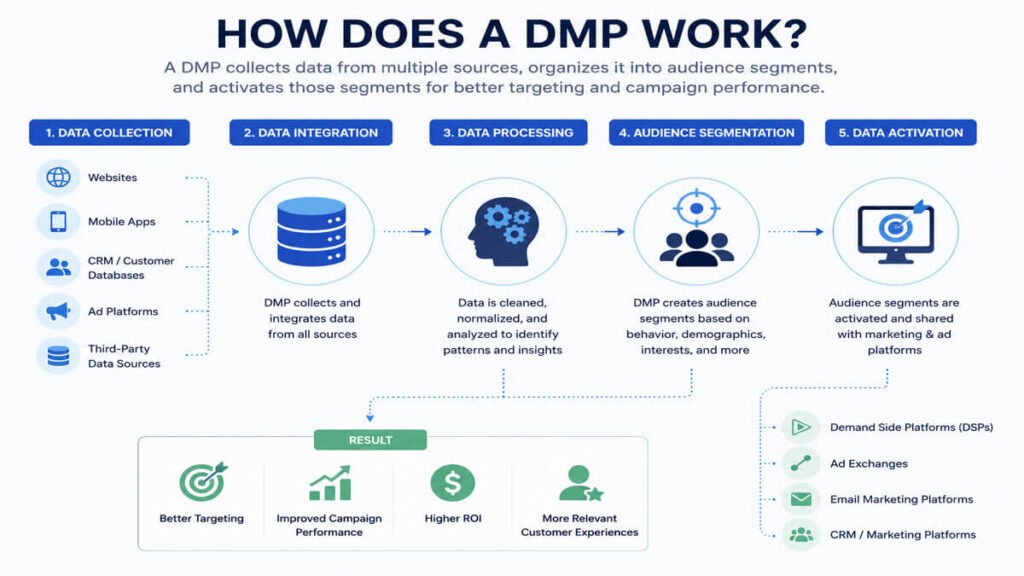
Behind the scenes, a DMP performs three core jobs.
First, it collects information.
This data may come from websites, apps, CRM systems, advertising platforms, and third-party providers.
Second, it organizes information.
The platform identifies patterns and groups similar users together.
Third, it activates audiences.
Those audience segments can then be used inside advertising platforms for targeting purposes. To better understand how DMPs work alongside demand-side platforms, it’s important to look at the relationship between audience segmentation and media buying.
That’s the process in its simplest form.
Collect. Organize. Activate.
Everything else is essentially built on those three steps.
Data Management Platform Examples
Some of the most widely known data management platform examples include:
Adobe Audience Manager
- Oracle BlueKai
- Lotame
- Salesforce Audience Studio
- Nielsen DMP
These data management platform examples became popular because they helped advertisers work with audience data at scale.
Although the market has evolved considerably, many marketers still study these platforms to understand how audience management works within programmatic advertising.
Top Data Management Platform Features
A top data management platform is rarely judged by how much data it stores.
Instead, marketers care about what they can actually do with that data.
The most valuable features often include:
Audience segmentation
- Data integration
- Identity resolution
- Reporting and analytics
- Audience activation
- Privacy controls
A top data management platform should help marketers move from information to action as quickly as possible.
After all, data by itself has very little value. The value comes from making better decisions because of it.
Are DMPs Losing Relevance?
Probably, this is one of the most controversial topics when it comes to advertising technologies.
And, definitely, the response to it is not straightforward either.
Privacy laws and consumer habits have changed the ways we collect data, and yet, CDPs have become more popular because of their unique capacity to deal with first-party customer data. If you’re evaluating modern marketing technology, it’s also worth understanding how customer data platforms compare with data management platforms before choosing the right solution.
But this doesn’t make DMPs redundant.
Many organizations still use them for audience segmentation and programmatic advertising workflows.
Rather than disappearing, DMPs are evolving alongside the rest of the advertising technology ecosystem.
FAQs
What is DMP in marketing?
In marketing, a DMP is a platform used to collect, organize, and manage audience data from multiple sources. Marketers use it to build audience segments and improve advertising performance.
What does DMP stand for?
DMP stands for Data Management Platform.
What are the 5 layers of a data platform?
The five common layers are:
- Data Collection
- Data Storage
- Data Processing
- Analytics and Insights
- Data Activation
Together, these layers help organizations turn raw information into useful business insights and marketing actions.