
What Is Header Bidding?
What is header bidding? The easiest way to understand it is to think of it as a live competition between advertisers happening in the background before an ad appears on a website.
Whenever somebody opens a webpage, there’s usually an empty advertising space waiting to be filled. Years ago, online advertising platforms handled this in a pretty rigid way. Advertisers were arranged in order, and each one got a turn. If the first advertiser accepted the impression, the process ended there. Nobody else got the opportunity to compete for that same placement.
The issue with that system was obvious. A different advertiser further down the line might actually have been willing to pay more for the impression, but never even got the chance.
Header bidding changed that process completely.
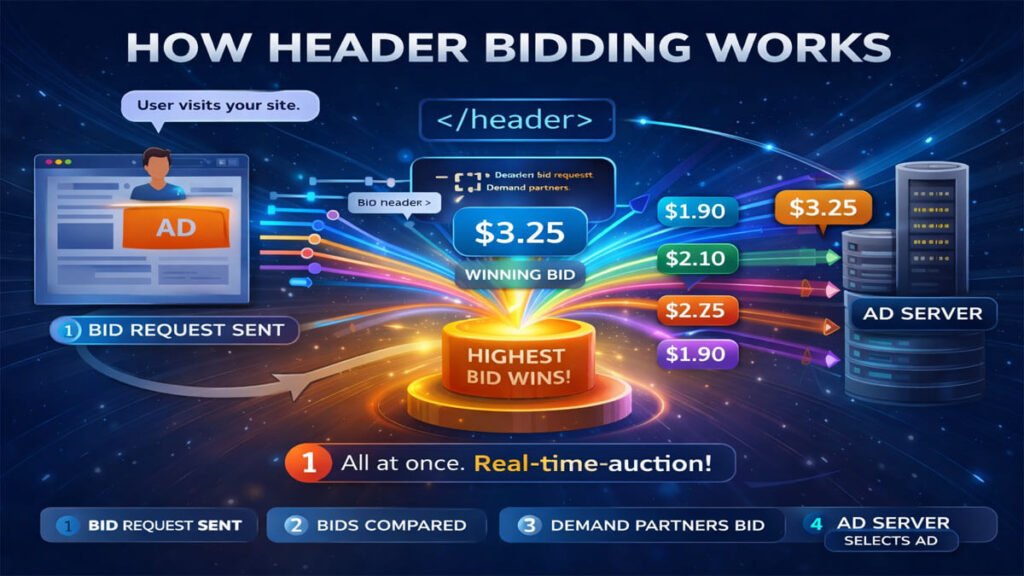
Instead of advertisers waiting one after another, multiple advertisers can now bid for the same impression simultaneously. The bids are compared instantly, and the winning ad is selected in real time before the page fully loads.
That’s really the core idea behind header bidding. It introduced a more open auction process into digital advertising instead of relying heavily on fixed priority systems.
Today, header bidding is used widely across the programmatic advertising ecosystem because modern digital advertising depends heavily on fast, automated auctions happening in milliseconds behind the scenes.
How Header Bidding Work
Ever wondered that how does header bidding work? The whole process takes place so rapidly that no one actually realizes what is going on.
As soon as someone accesses a web page, an ad impression becomes available for different advertisers at the same time. The advertisers themselves make decisions about whether they find it useful based on factors like their target audience, etc.
In case they find it attractive enough, they bid immediately.
After the bids are placed, the highest bidder gets picked up and the ad is displayed.
All of this usually happens within milliseconds. This entire process is part of how modern programmatic advertising systems buy and sell digital ads automatically in real time.
From the outside, it simply looks like a webpage loading normally. But underneath that simple experience, several advertising systems may already have communicated with each other before the user even notices the ad.
This is one reason programmatic advertising often feels difficult to understand at first. Most of the activity happens invisibly and extremely fast.
Why Did Header Bidding Become So Important?
One of the biggest reasons header bidding became popular was because it made digital advertising auctions feel more competitive.
Earlier systems often depended too much on fixed relationships and predefined rankings. Some advertising partners automatically received priority access, while others only got opportunities later in the process.
Header bidding removed much of that limitation by allowing advertisers to compete together in real time.
That changed the auction environment quite a bit.
Instead of relying mainly on hierarchy, the process became more driven by actual demand at that exact moment. With time, this approach made online ad auction processes more open and flexible when compared to previous practices.
Header bidding grew increasingly popular as programmatic advertising kept spreading over various media channels including web sites, applications, video, and streaming services.
Nowadays, header bidding is seen as a standard component of modern advertising infrastructure.
Why is Header Bidding Important for Programmatic Ads?
The essence of programmatic ads involves automation and making decisions within the smallest possible time period. In fact, billions of ad spots are automatically purchased and sold on the web.
Header bidding gained importance owing to its natural integration into this process of automated auctions.
Rather than complicating this process, header bidding made it easy to conduct multiple auctions before choosing a winner. That made the overall auction process more dynamic without disrupting the user experience.
It also helped move the industry further toward real-time competition instead of static advertising relationships.
That’s one reason header bidding is still closely connected with modern programmatic advertising today.
Is Header Bidding Still Used Today?
Yes — very heavily.
Even though advertising technology keeps evolving, the idea behind header bidding is still highly relevant because digital advertising still depends on fast auction systems.
Today, header bidding is commonly used across:
Websites
- Mobile applications
- Video advertising
- Streaming services
- Connected TV platforms
As digital advertising becomes increasingly automated, technologies that improve auction competition and advertiser access continue to remain important across the broader ad-tech ecosystem.
Final Thoughts
What then is header bidding in simple terms?
Header bidding is an approach applied in the field of programmatic advertising, whereby different advertisers bid on the same space at once before the actual display of the advertisement takes place.
This implies that the process of bidders taking turns to make their offers is bypassed as everybody bids simultaneously.
The impact of this simple alteration proved to be revolutionary and was a huge leap forward for digital advertising technology.
FAQs
How does header bidding work?
The principle behind header bidding is that ad space is sent out at once to several advertisers before one of them is selected as the winner of the ad space. This is done through a bidding process.
Why is it called header bidding?
The term originally came from the fact that the auction process took place inside the header section of a webpage before advertisements loaded.
What are the types of header bidding?
The most common types include client-side header bidding, server-side header bidding, and hybrid setups that combine both approaches.