
Programmatic Advertising Process
The programmatic advertising process can be defined as a mechanism regulating the buying, selling, and placement of advertisements on the internet. With every action a user makes while visiting a particular web page, watching videos, or using some application, advertising networks determine which ad is going to be shown.
What is important to understand is that most of the time, people do not see all the efforts put into this because everything happens extremely fast. The thing is that many advertising platforms interact with each other at the same time when making their decision within just a few seconds.
As automated advertising has become the norm within recent years, the need to know more about this process is critical for every advertiser, brand, agency, marketer, etc.
What is the Programmatic Advertising Process?
Programmatic Advertising Process is an automation system employed in buying and selling of online advertisements.
In the olden days of advertisements, brands had to connect directly to the sites they needed for placing their ads. Their campaigns would be manually arranged, prices set, and then executed. Programmatic advertising brought an easy way to automate media buying and audience targeting through modern advertising technology.
In modern times, when an individual visits a site page, a programmatic ad auction will take place automatically behind the scenes. Interested advertisers would then bid on the ads through the use of advertisement platforms.
This entire programmatic advertising process step by step takes place while the webpage is still loading.
The system depends on several advertising technologies, including:
- DSPs
- SSPs
- Ad exchanges
- Real-time bidding platforms
- Audience targeting systems
Programmatic advertising is quite an easy concept to understand. The first aim of advertisers would be to find the correct audience, and for publishers it would be to market their unused inventory.
In addition, many companies work with programmatic campaign management experts to improve targeting, campaign efficiency, and advertising performance. performance.
Programmatic Advertising Process Steps
To understand how this system works, it helps to look at the programmatic advertising process explained step by step.
Step 1 – Campaign Setup Begins
The process starts when an advertiser launches a campaign inside a Demand-Side Platform.
At this stage, advertisers usually define:
- Budget
- Audience targeting
- Geographic regions
- Devices
- Ad formats
- Campaign objectives
- Creative assets
There exist campaigns which are aimed at traffic or impressions, and other ones that are aimed at conversion, app installation, video viewability, or lead generation.
After launching the campaign, the DSP begins looking for ad opportunities that match the criteria.
Step 2 – A Website Generates an Ad Request
When someone opens a website or mobile app, the publisher creates an ad impression.
An ad request is then sent into the advertising ecosystem. That request may include details such as:
- Device type
- Browser
- Website category
- Approximate location
- Audience signals
The information helps advertisers determine whether that user fits their campaign requirements.
All of this happens automatically in the background while the page loads.
Step 3 – Bidding Competition Among Advertisers
The DSP analyzes the impression to determine its worth to the advertiser.
If the visitor fits the target audience for the campaign, then bidding will be done automatically.
For instance, an advertiser who deals with health and fitness products may place higher bids on impressions from people visiting pages that are related to workouts. Another advertiser whose target market is totally different will not place any bid.
Here, it is clear that programmatic advertising is more efficient compared to media buying because the advertiser focuses on targeted users.
Step 4 – The Ad Exchange Runs the Auction
After bids are submitted, the ad exchange compares them in real time.
The ad exchange acts like a marketplace where advertisers compete for available inventory.
Multiple advertisers may bid for the same impression simultaneously. The exchange evaluates the bids and selects the winning ad according to auction rules and bid value.
This process usually finishes within milliseconds.
Modern advertising ecosystems can also involve:
- Header bidding is commonly used to increase competition between advertisers before the final auction takes place
- Preferred deals
- Private marketplaces
- Supply path optimization
These systems help improve bidding competition and inventory efficiency across digital advertising platforms.
Step 5 – The SSP Sends the Winning Advertisement
The Supply-Side Platform helps publishers manage and sell advertising inventory.
Once the auction finishes, the SSP receives the winning bid and sends the selected advertisement to the publisher’s ad server.
The SSP helps publishers:
- Manage inventory more efficiently
- Connect with multiple advertisers
- Increase competition for impressions
- Improve advertising operations
Without SSPs, publishers would need to manage advertising demand manually across multiple partners.
Step 6 - The Advertisement Appears
After the winning bid is selected, the advertisement loads on the website or app.
From the user’s perspective, the process feels simple because the ad appears almost instantly. However, several advertising systems have already exchanged information, processed audience signals, compared bids, and completed an auction before the page fully loads.
That speed is one of the defining features of the programmatic advertising process step by step.
The diagram below shows the programmatic advertising process steps and how an ad moves from the advertiser to the user through different platforms.
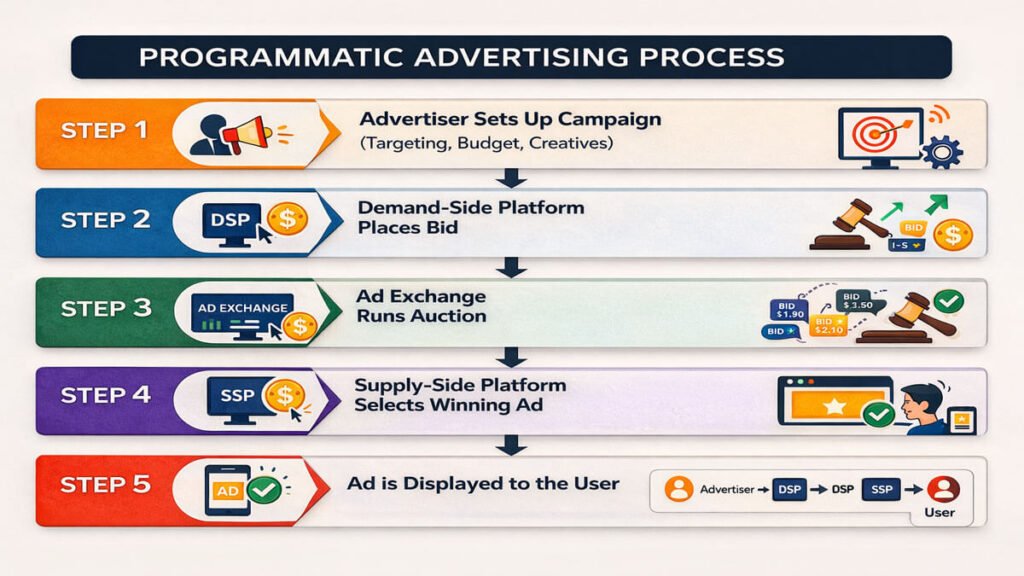
Programmatic Advertising Process Diagram
A standard programmatic advertising process diagram usually follows this flow:
Advertiser → DSP → Ad Exchange → SSP → Publisher → User
This structure explains how digital advertising moves through different systems before reaching the final user.
The advertiser uses a DSP to place bids automatically. The ad exchange handles the auction process, while the SSP helps publishers manage inventory and advertising demand.
Finally, the selected ad is displayed to the user.
Although the process may sound technical at first, the main goal is straightforward: use automation to connect advertisers with the right audience faster and more efficiently.
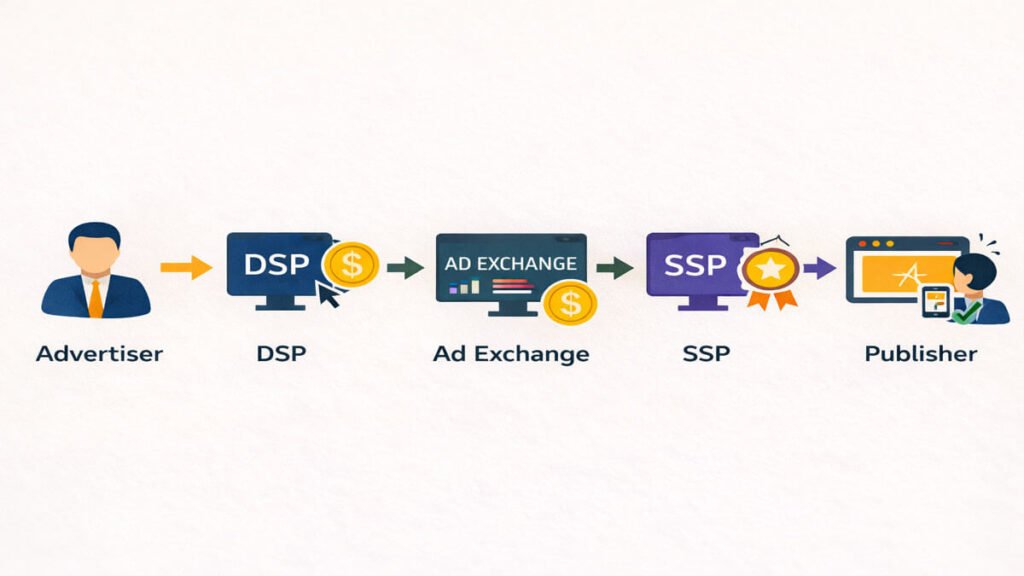
Programmatic Advertising Process Step by Step Example
Let’s look at a simple example.
Suppose someone opens a sports news website.
As the page loads, the website sends an ad request through its SSP. The request reaches an ad exchange where advertisers are already waiting to compete for impressions.
A sportswear company interested in sports audiences may decide to place a bid through its DSP. Other advertisers may also bid for the same impression.
The ad exchange compares all bids and selects the winning advertiser. The selected ad is then returned through the SSP and displayed on the website.
This complete programmatic advertising process explained usually takes less than a second.
Even though the user only sees a single advertisement, multiple automated systems are working together behind the scenes to make that placement happen in real time.
Benefits of the Programmatic Advertising Process
Programmatic advertising became popular because it improves efficiency across digital advertising.
Better Audience Targeting
Advertisers can target users based on:
- Interests
- Browsing activity
- Device type
- Demographics
- Location
- Online behavior
This helps improve ad relevance and reduce wasted spend.
Faster Media Buying
Automation removes much of the manual work involved in traditional campaign buying and management.
Advertisers can run campaigns across multiple websites and apps more efficiently.
Real-Time Optimization
Campaign settings can be adjusted while campaigns are running.
Advertisers can optimize:
- Budgets
- Bids
- Placements
- Targeting
- Creative performance
- Improved Campaign Efficiency
Real-time auctions help advertisers compete more intelligently for valuable impressions while improving inventory value across advertising platforms.
Better Reporting and Insights
Programmatic systems provide detailed campaign reporting and audience analytics that help businesses make more informed advertising decisions.
Many brands also use programmatic consulting services to improve bidding strategies, ad operations, campaign structure, and advertising infrastructure.
Conclusion
Digital advertising was revolutionized by the programmatic advertising model through automation of the traditional media buying process, which involved bidding for and serving ads in real time.
It has become possible for today’s marketers to buy ad spaces on websites, applications, and other digital platforms instantly through automated advertising systems.
All the way from demand side platforms, supply side platforms, ad exchanges, targeting systems, and much more, everything that is done throughout the process is designed to ensure the efficiency and effectiveness of the entire ad purchasing process.
As such, the process of digital advertising continues to advance, understanding how the process of programmatic advertising works is essential.
FAQs
What is the programmatic advertising process in simple words?
Programmatic advertising refers to the automation of the process of buying and selling digital advertising in real time. The advertisers make automatic bids, and the ad that wins shows up almost immediately on the screen.
What are the main steps in the programmatic advertising process?
The main steps include campaign setup, ad request generation, DSP bidding, ad exchange auctions, SSP selection, and final ad delivery.
Why is the programmatic advertising process important in digital marketing?
It helps advertisers automate media buying, improve targeting accuracy, optimize campaigns faster, and increase advertising efficiency across digital platforms.