
So what is a Demand Side Platform? The phrase ‘demand side platform’ relates to a system that is responsible for automating the buying process in which advertisers, and their agencies, purchase digital advertisements on different media channels (such as websites, mobile apps, video channels, among others).
It is vital to know the role of demand side platforms when discussing today’s programmatic advertising since these enable advertisers to plan campaigns, reach targeted audiences, and control their budgets through automated bidding.
Without the help of DSPs, it would be very difficult to purchase large volumes of digital advertising without negotiating deals one by one with numerous publishers.
What Is a Demand Side Platform?
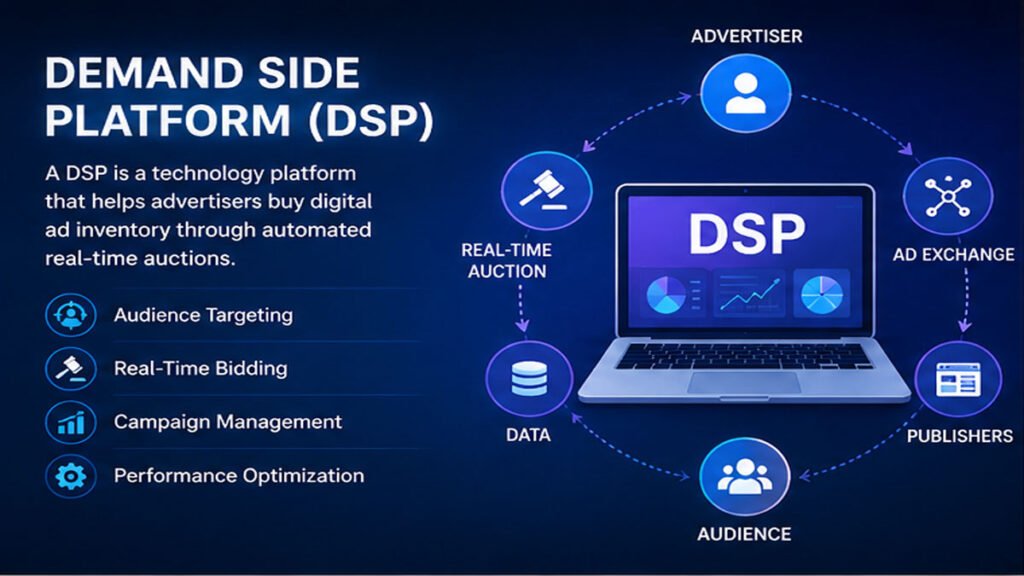
A demand side platform refers to an application used by marketers for buying advertising inventory via programmatic platforms.
Marketers no longer have to buy advertising spaces manually from each publisher individually; instead, they do this using a DSP.
A demand side platform helps advertisers:
- Buy ad inventory automatically
- Reach specific audience segments
- Manage multiple campaigns
- Optimize advertising spend
- Track campaign performance
- Participate in real-time auctions
The primary purpose of a DSP is to help advertisers purchase the right impression for the right audience at the right price.
Why Demand Side Platforms Became Important
Prior to the popularity of programmatic advertising, the process of digital advertising was quite manual in nature. Today, many advertisers also use automated direct buying arrangements with publishers for premium inventory access and greater campaign predictability. Advertisers would need to communicate with individual publishers, bargain for prices, handle insertion orders, and track their campaigns manually through multiple systems.
The more digital advertising evolved, the less efficient the process was becoming.
Demand-side platforms addressed the problem of inefficiency. Today, an advertiser can get millions of opportunities to place advertisements per second, without having to deal with individual publishers at all.
Efficiency is what has made programmatic advertising so successful.
How Does a Demand Side Platform Work?
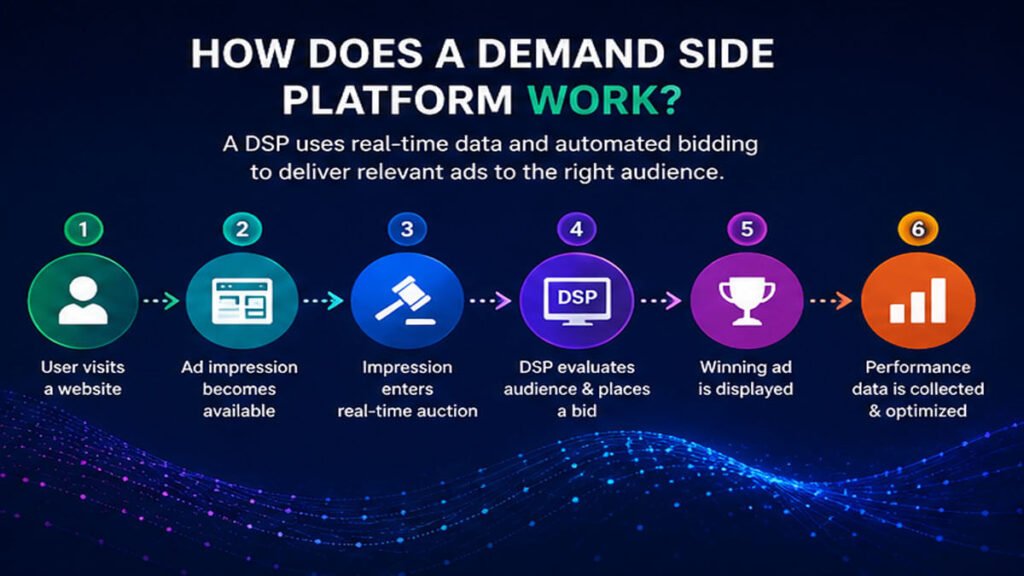
Understanding how does a demand side platform work requires understanding the real-time auction process that determines which advertiser wins an impression.
When a user visits a website or opens an app, an advertising opportunity becomes available. That opportunity enters a programmatic auction where multiple advertisers compete for the impression.
A simplified process looks like this:
- A user visits a website.
- The publisher makes an ad impression available.
- The impression enters an auction.
- Advertisers connected through DSPs evaluate the opportunity.
- The DSP analyzes audience and campaign data.
- Automated bids are submitted.
- The winning advertisement is displayed.
This process typically takes less than a second.
Modern DSPs use advanced algorithms, audience data, and machine learning to determine how much each impression is worth before placing a bid. DSPs are also commonly used to access private marketplace deals, where publishers make premium inventory available only to selected advertisers.
Demand Side Platform Advertising
Demand side platform advertising refers to the process of purchasing digital advertising inventory through a DSP rather than through manual media buying methods.
Today, demand side platform advertising is widely used across:
- Display advertising
- Video advertising
- Mobile advertising
- Connected TV (CTV)
- Audio advertising
- Native advertising
Among the key benefits of DSP advertising is that of scale. With DSPs, a marketer is able to create campaigns on many publishers simultaneously without losing control of targeting, bids, budgets, and reporting.
This cannot be achieved easily by means of conventional approaches to advertising purchase.
The Role of DSPs in Programmatic Advertising
A demand side platform does not operate independently. It is part of a larger programmatic advertising ecosystem.
DSPs regularly interact with:
- Advertisers
- Agencies
- Ad Exchanges
- Supply Side Platforms (SSPs)
- Data Providers
- Publishers
A typical flow looks like this:
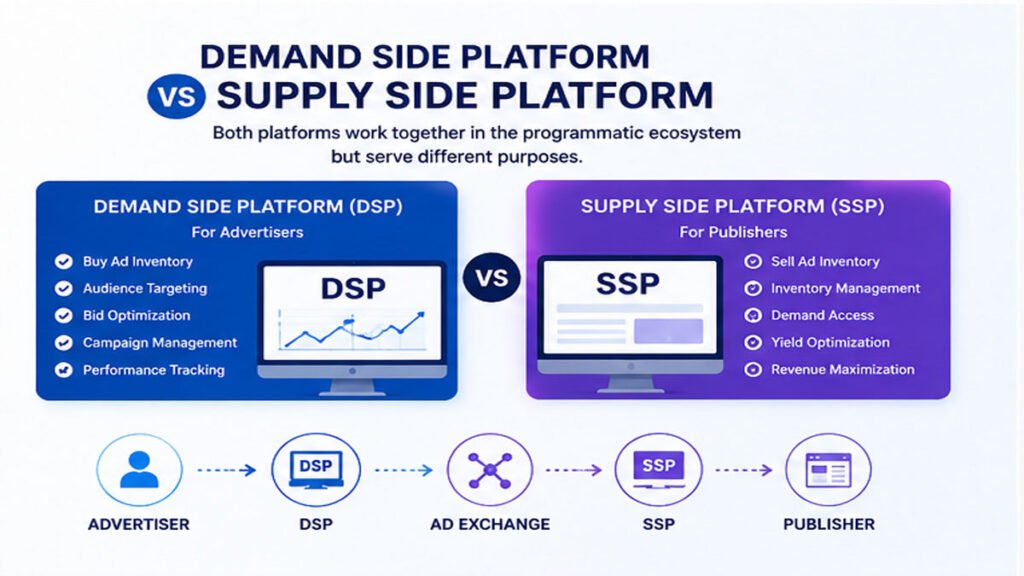
Advertiser → DSP → Ad Exchange → SSP → Publisher
The DSP works on behalf of the advertiser in the buying process, whereas the SSP works on behalf of the publisher in the selling process.
These tools assist in forming a digital marketplace where advertising inventory is traded, helping buyers and sellers participate in automated transactions.
Difference Between DSP and SSP
One of the most confusing things about the process of programmatic advertising is the difference between the DSP and SSP.
Although both participate in automated advertising transactions, they serve completely different users.
Demand Side Platform (DSP)
A DSP is designed for advertisers and agencies.
Its responsibilities include:
- Campaign management
- Audience targeting
- Budget control
- Bid optimization
- Performance monitoring
The goal of a DSP is to help advertisers buy advertising inventory efficiently.
Supply Side Platform (SSP)
An SSP is designed for publishers and acts as the technology used by publishers to manage and monetize inventory across programmatic advertising environments.
Its responsibilities include:
- Inventory management
- Demand access
- Auction coordination
- Yield optimization
- Revenue maximization
The goal of an SSP is to help publishers sell advertising inventory efficiently.
In simple terms:
Advertisers buy through DSPs.
Publishers sell through SSPs.
Understanding the relationship between a demand side platform vs supply side platform is fundamental to understanding how programmatic advertising works.
Benefits of Using a Demand Side Platform
Improved Audience Targeting
DSPs allow advertisers to target audiences based on demographics, interests, behavior, devices, geography, and other signals.
Better Budget Control
Advertisers can manage spending across multiple campaigns while controlling bids and daily budgets from one platform.
Real-Time Optimization
Campaigns can be adjusted continuously based on performance data, helping improve efficiency and return on investment.
Access to Massive Inventory
A demand side platform provides access to inventory across thousands of websites and applications through a single connection.
Operational Efficiency
Automation eliminates much of the manual work traditionally associated with media buying.
Why DSPs Matter for Modern Advertisers
The digital advertising landscape has become increasingly fragmented. Advertisers now need to reach audiences across websites, apps, streaming services, mobile devices, and connected TV environments.
Managing these channels manually would be extremely difficult.
A demand side platform simplifies this complexity by providing centralized access to inventory, targeting capabilities, reporting tools, and campaign management features.
As advertising technology continues to evolve, DSPs remain one of the most important components of the programmatic ecosystem.
Conclusion
A demand side platform, its functions and importance should be known to all persons associated with online advertising. A demand side platform allows marketers to make purchases of advertising spaces in a convenient way, target their audience, conduct campaigns, and optimize them.
Since the development of programmatic advertising only continues to evolve, DSPs will be at the heart of it for many years to come.
FAQs
What is the demand-side platform?
The Demand Side Platform is an advertising technology platform which allows for buying ads programatically. That is, by using ad automation systems, marketers and agencies can purchase digital ads. Using such technology platforms makes campaign organization, targeting, and bidding easier for marketers.
What is an example of a DSP?
Some popular DSPs are DV360 (Display and Video 360) from Google, The Trade Desk, Amazon DSP, Yahoo DSP, and MediaMath. Through these platforms, advertisers can bid for ad space automatically through auctions.
Difference between DSP and ad exchange
The main function of a DSP is advertising purchase from publishers. In contrast, an ad exchange provides a place for trading inventory of online advertising resources. A DSP can be integrated into an ad exchange to take part in programmatic auctions.
Is it possible to use demand side platforms for small businesses?
There are DSP solutions for various businesses, regardless of their size. Nevertheless, platform requirements, minimal budgets, and additional features depend on particular providers.
Can we use a DSP only for display advertising?
Demand side platforms can be used for displaying different types of advertising, such as display, video, mobile, native, audio, and connected TV ads.
Why should we use DSPs in programmatic advertising?
DSPs allow advertisers to automate media purchases, improve targeting, increase the effectiveness of campaigns, and manage ad budgets more efficiently.