
What Is Ad Exchange
So, what is ad exchange, really? Have you ever clicked on any website and an advertisement pops up instantly without your thinking much about it? Well, that would be the result of an ad exchange functioning successfully in the background.
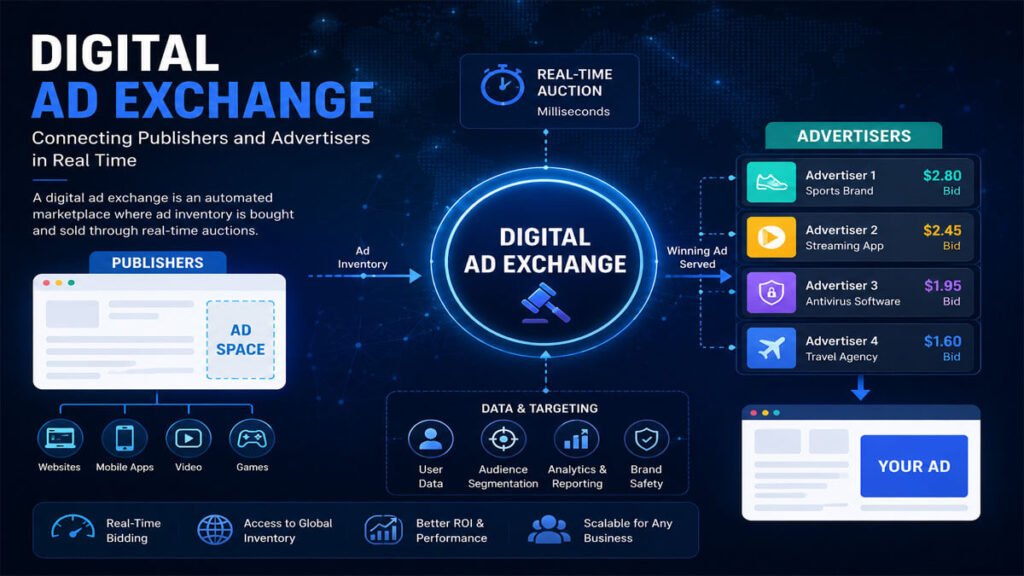
In simple terms, an ad exchange is a kind of market place where publishers, owning websites or applications, come to put forward their inventory, which then is bid upon by advertisers. While most people do not even care to think of all the processes taking place in such a short span of time from when we click anything to when we actually see the ads popping up. For publishers, it’s a chance to earn money by opening up their ad space to lots of potential buyers. That’s a big reason why ad exchanges have become such a huge part of programmatic advertising.
How Does an Ad Exchange Work
We will address the question of how ad exchanges work using a practical example.
Suppose that you are reading a tech blog to gather information about cybersecurity. Before the web page even finishes loading, ad placements for interested customers have already begun.
A software company might jump in. A cybersecurity firm might, too. Another advertiser might decide you’re not their target audience and pass.
The ad exchange acts as the marketplace where advertisers compete for impressions through automated real-time auctions. Advertisers submit bids based on how much that specific impression is worth to them. The exchange processes the bids, picks a winner, and serves that ad to you. All of it usually happens in milliseconds.
You just see the page load. But behind the curtain, a lightning-fast auction just took place. That ability to evaluate impressions one by one is a huge reason programmatic advertising works so well.
Digital Ad Exchange
A digital ad exchange has completely changed how ad space is bought and sold.
Before automation, buying media meant long email chains, paperwork, and manual campaign tweaks. Running ads across dozens of websites was a logistical headache. Now? Advertisers can tap into inventory from tons of different sources through one system using the technology advertisers use to buy inventory automatically. Publishers can show their space to way more potential buyers than they’d ever reach on their own.
The result? Advertising becomes quicker, more efficient, and scalable. It allows you to refine your campaign strategy on the fly, improve your targeting efforts, and use real demand as your guide.
When entering the programmatic advertising field, an ad exchange gives businesses the tools necessary to make it happen. It’s one part of the entire process, but it’s a critical component none the less.
Ad Exchange Examples
Sometimes a few ad exchange examples make the whole thing feel less abstract.
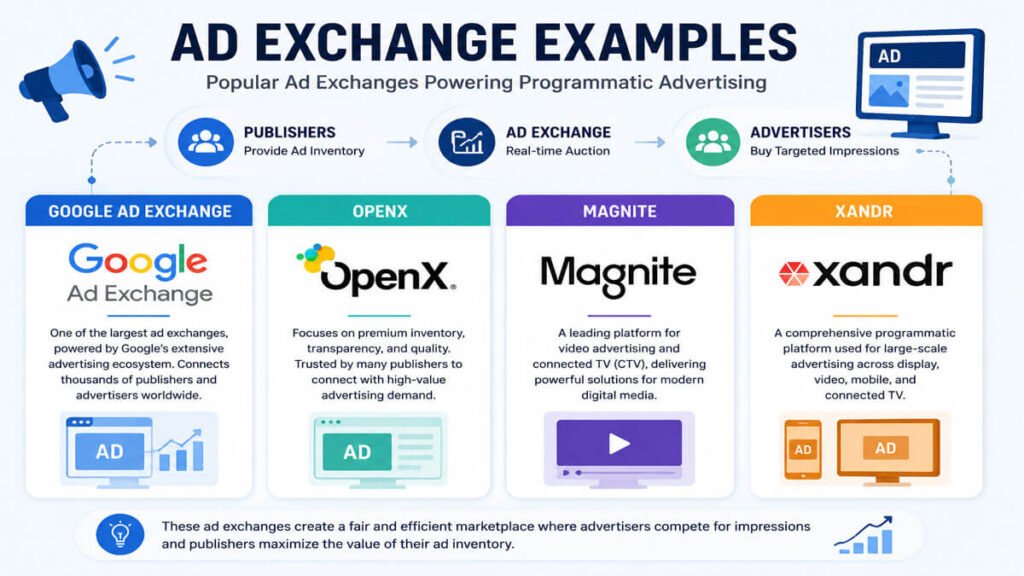
Google Ad Exchange is probably the most well-known. Thanks to Google’s massive advertising ecosystem, it connects a huge number of publishers and advertisers.
- OpenX focuses on premium inventory and transparency. Lots of publishers use it to find quality advertisers.
- Magnite is a big name in video ads and connected TV.
- Xandr is also widely used for large-scale programmatic ad transactions.
But instead of getting hung up on names, think about what these ad exchange examples enable. Imagine you run a popular sports website. A sportswear brand, a streaming service, and a fitness app might all want to show an ad to the same visitor. The ad exchange creates a fair, fast auction for that opportunity. Without it, managing all those relationships at scale would be a nightmare.
Open Ad Exchange
So, what is an open ad exchange? This is a very self-explanatory term. An open ad exchange simply means a system whereby the inventory is available to many different kinds of advertisers.
The main advantage of open ad exchanges is the element of competition among the parties. Advertisers seeking more control often prefer fixed-price inventory buying without participating in open auctions. The more advertisers there are willing to bid on inventory, the higher the chances that it would be sold at the best possible prices, and also provide the most options for the buyer as well. That said, publishers still retain the ability to regulate the process by controlling factors such as pricing, brand safety considerations, and even advertiser eligibility.
One reason why open ad exchanges are preferred is because of the scalability they bring to the process of selling ad spot. Publishers seeking more control over advertiser access often choose private marketplace advertising instead of making inventory available to all buyers.
Why All This Matters
While ad exchanges operate in stealth mode, they have a tremendous impact on both advertisers and publishers. For advertisers, they offer a highly efficient solution for buying media. For publishers, they allow reaching a wider audience by opening doors for new customers. However, probably the most significant contribution of ad exchanges is making programmatic advertising possible.
Users don’t even realize that—yet ad exchanges significantly contribute to placing ads on their screens.
FAQs
What does an ad exchange do?
An advertisement exchange can be viewed as an online market where advertisers bid for ad slots, while publishers sell their advertising inventory. The role of ad exchanges is to facilitate the buying and selling process through automation and real-time bidding capability.
Is an ad exchange safe?
Yes, usually. Respectable ad exchanges have measures to prevent fraud, control quality, and ensure brand safety. Having said that, however, advertisers and publishers should always choose their partners wisely and monitor their performance closely.
What is an example of an ad exchange?
Examples of such services include Google Ad Exchange, OpenX, Magnite, and Xandr. They are used in order to help conduct transactions with programmatic ads between sites, apps, videos, and other digital formats.