
Customer Data Platform vs Data Management Platform
In case when you consider a comparison between a Customer Data Platform vs Data Management Platform, you try to find out a very important thing – which tool is going to be able to assist your business in becoming more effective in terms of dealing with data? Though the names of these platforms are very similar, their purpose is rather different.
Customer Data Platform Meaning
A Customer Data Platform is a technology that accumulates information about customers from various sources, such as website visits, CRM database entries, email marketing, mobile applications, and purchases. All these data points are brought together in one customer profile that is updated constantly. This technology enables marketing departments to know about customers’ actions, to conduct personalized campaigns, and provide a consistent experience.
To better understand the advertising side of the ecosystem, learn how data management platforms organize advertising audiences.
Data Management Platform Meaning
A Data Management Platform is created specifically for advertising purposes. While Customer Data Platforms create comprehensive profiles of the existing customers, Data Management Platforms form segments of the audience by specific criteria like behavioral data, interest, demographics, or context.
If you’re interested in the technical workflow, explore how a data management platform processes audience data from collection to activation.
Difference between CDP and DMP
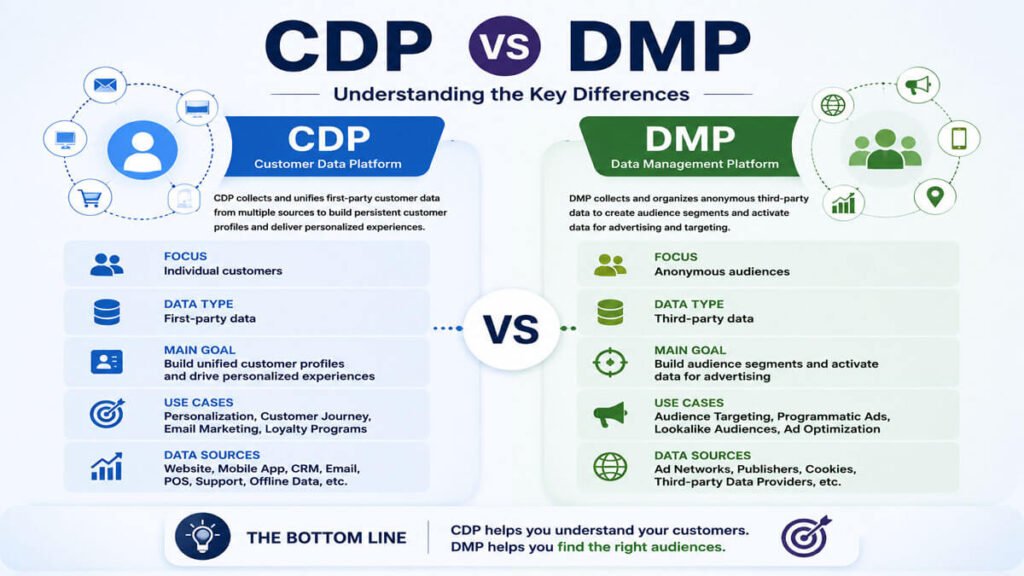
The main difference lies in the purpose behind each platform. The CDP platform enhances relationships through maintaining customer profiles that stay persistent. The DMP increases ad effectiveness through the organization of audiences. The former has a focus on personalization while the latter has a focus on acquiring audiences.
Customer Data Platform VS Data Management Platform: Source of Data
The source of information for a CDP is the first-party customer data. The source of information for a DMP is first-party, second-party, contextual, and third-party data. However, due to new privacy issues, the first-party and contextual data are becoming more important for DMPs.
CDP and DMP: Main Use Cases
The following are some of the reasons why enterprises rely on CDPs: email personalization, customer loyalty, journey mapping, and better customer experience management. The main use cases of DMPs involve audience segmentation, media buying, lookalike modeling, and programmatic ad optimizations.
You can also see how DMPs work alongside demand-side platforms during audience targeting and campaign execution.
Customer Data Platform and Data Management Platform: Examples
Some of the examples of Customer Data Platforms are Salesforce Data Cloud, Adobe Real-Time CDP, Twilio Segment, Treasure Data, and mParticle. Some examples of the most widely-used Data Management Platforms are Adobe Audience Manager, Lotame, Permutive, and Nielsen DMP.
Is It Possible for a CDP and DMP to Function Together?
Yes, because many businesses make use of both these platforms. The CDP offers valuable customer intelligence while the DMP is useful in activating audience insights and putting the information to use for advertising purposes. Both the CDP and DMP can help you with customer retention and customer acquisition.
Which One Do You Need?
Use CDP when you need to build relationships with customers and personalize their experience. Use DMP when you are concerned about advertising online.
Conclusion
Deciding on whether to use Customer Data Platform or Data Management Platform is based on your goals. Companies that care about their customers’ experiences should use CDP, while companies that are interested in advertising performance should use DMP. The knowledge of capabilities of both types of platforms allows making the right investment decisions for the future.
FAQs
What is the difference between a data management platform and a customer data platform?
Customer Data Platform (CDP) creates persistent customer profiles based on first-party data. Data Management Platform (DMP) builds audience segments to be used for advertising and programmatic campaigns. Thus, one can say that CDP is designed for helping brands understand their customers, while DMP is intended for identifying new customers.