
Many advertisers invest years purchasing media through open auctions while ignoring that some of the most valuable ad spots never even enter an open auction.
If you see advertisements from a reputable financial institution on a high-end financial site or advertisements from a luxury brand on a top publisher, then chances are that the media was bought via private marketplace, not through a regular open auction exchange.
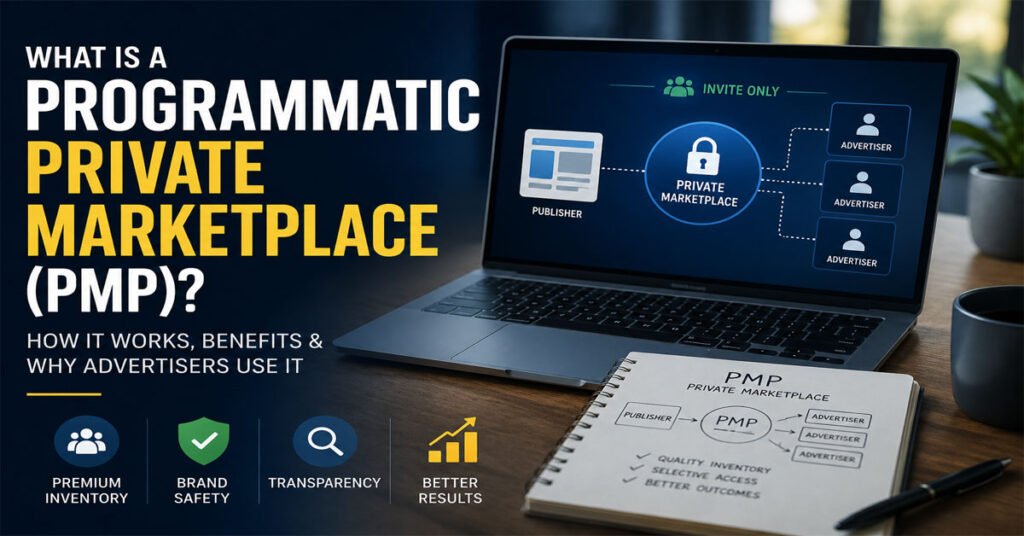
The concept of a programmatic private marketplace allows for a limited number of advertisers to purchase media directly from the publisher. The process remains programmatic as the bidding takes place automatically. But unlike the regular open exchanges, not everybody gets a chance.
This is beneficial for both parties: publishers have the ability to choose their partners while advertisers have access to media which is less prone to fraud and competition.
What Is a Private Marketplace?
At its core, a private marketplace is exactly what it sounds like: a private version of a programmatic auction.
In an open marketplace, almost anyone with access to a DSP can bid on available impressions. Publishers have limited control over who eventually wins those auctions.
A PMP changes that.
Rather than allowing anyone to buy their inventories, publishers target certain buyers like advertisers, agencies, or brands for the buying process. They get access using Deal IDs and are only able to bid for the particular inventories in that deal.
This idea gained popularity due to the desire by publishers to maintain control while retaining the efficiency of the programmatic approach. Publishers no longer had to do manual negotiations but could automate while controlling access.
That’s a big reason why PMPs have become common among premium publishers.
How a Programmatic Private Marketplace Actually Works
The easiest way to understand a programmatic private marketplace is through a real-world example.
Imagine a well-known business publication with an audience made up of executives, investors, and business owners.
That publisher knows its audience is valuable. Instead of selling homepage inventory through an open auction, it creates a private deal and invites only a handful of financial institutions, software companies, and investment firms.
Those advertisers receive a Deal ID. The entire buying process is typically managed through a Demand-Side Platform (DSP), which allows advertisers to activate Deal IDs and bid on PMP inventory.
Whenever inventory becomes available, they compete against one another through their DSPs. The auction still happens automatically and in real time, but participation is restricted. While the mechanics resemble real-time bidding (RTB), the key difference is that only invited buyers can participate.
From the outside, nothing looks different. The user sees an ad. The publisher earns revenue. The advertiser reaches its audience.
Behind the scenes, however, the transaction happened within a programmatic private marketplace rather than a public exchange.
For marketers new to Deal IDs, DSPs, and PMP buying strategies, structured programmatic advertising training can help shorten the learning curve and prevent costly campaign mistakes.
Why Publishers Love PMPs
Ask most publishers why they use PMPs and you’ll rarely hear them mention technology first.
The conversation usually starts with control.
Publishers invest significant time and money building their audience. The last thing they want is a low-quality advertiser damaging that experience.
Private marketplaces allow them to decide who can access inventory and who cannot.
There’s also the revenue side.
A premium product can attract a high price when it is available exclusively. Advertisers will be ready to pay a higher cost if they realize that they are bidding for scarce and quality space.
A number of companies have found it easier to balance automation and exclusivity through PMPs.
Private Marketplace Advertising Isn't Just About Premium Inventory
One mistake people make is assuming private marketplace advertising is only about getting better placements.
Inventory quality matters, of course, but that’s only part of the story.
Advertisers are increasingly focused on transparency. They want to know where impressions come from. They want confidence that inventory is genuine. They want fewer surprises.
That’s where private marketplace advertising becomes attractive.
Because the relationship between publisher and advertiser is often much clearer, buyers gain more visibility into what they’re actually purchasing.
Another reason private marketplace advertising continues to grow is brand safety. Many advertisers would rather pay slightly more for inventory if it means reducing the risk of appearing next to questionable content.
For large brands, reputation often matters more than finding the absolute cheapest impression.
PMP Private Marketplace vs Open Auction
A common question is whether a PMP is automatically better than an open exchange.
Not necessarily.
A PMP private marketplace is designed around quality and control. Open auctions are designed around scale.
If your goal is to reach as many users as possible at the lowest cost, open exchanges may be perfectly suitable.
If your goal is to appear on premium publishers, gain more transparency, and compete for higher-quality inventory, a PMP private marketplace often makes more sense.
Most sophisticated advertisers don’t choose one or the other.
They use both.
Open auctions help deliver scale. PMPs help deliver quality. Most open auctions take place through an ad exchange, where inventory is made available to a much broader pool of advertisers.
Together, they create a more balanced media strategy.
What Is a Private Marketplace Definition?
If someone asks for a simple private marketplace definition, here’s the shortest explanation:
A private marketplace is an invitation-only programmatic auction where approved advertisers can bid on publisher inventory.
That private marketplace definition covers the basics, but it doesn’t tell the whole story.
A better way to think about it is as a controlled environment where publishers maintain more influence over who accesses their inventory.
Another useful private marketplace definition is that PMPs sit between open exchanges and direct advertising deals. They combine the automation of programmatic buying with some of the control traditionally associated with programmatic direct campaigns.
Why More Advertisers Are Testing PMPs
Not so long ago, quite a number of marketers obsessed with reach.
The subject of the conversation has become dramatically different now.
The concerns such as the issues of visibility, transparency, fraud, quality of the inventory, and brand safety became much more important.
Thus, the programmatic private marketplaces have transformed from being innovative and unpopular ways of trade to becoming industry standards. Many brands work with a programmatic advertising consulrtancy to identify premium PMP opportunities, negotiate deals, and improve campaign performance across multiple channels.
Nowadays, quite a number of marketers understand that impressions should be valued by their quality.
In certain cases, it is much more advantageous to reach out to a smaller group of individuals in an environment of higher quality than to pursue a larger target audience in a poor environment.
FAQs
What is a private marketplace (PMP)?
A PMP is an invite-only auction, which allows approved advertisers to make buys on publishers’ inventory via programmatic buying.
What is private marketplace advertising?
Private marketplace advertising involves making buys on digital advertising inventory using private auctions available to select advertisers only.
What is a PMP private marketplace?
A PMP private marketplace is a restricted auction environment where invited advertisers compete for inventory offered by publishers.
What is the private marketplace definition?
The most common private marketplace definition is an invitation-only programmatic marketplace where approved buyers gain access to publisher inventory.