
If you have been wondering how the advertisement shows up on the webpage in no time, then most likely you are looking at real time bidding at work.
The majority of internet users are not aware of what is going on behind the scenes. You visit a website, view a page, and an advertisement pops up. The truth is that behind the scene a small auction happens within no time, where advertisers bid on showing their message to the particular visitor.
This form of bidding is known as Real Time Bidding or RTB.
RTB has revolutionized the digital advertising market in many ways. For instance, instead of buying large inventories of digital media in hopes that the desired audience will be exposed to them, advertisers can now analyze each impression and then bid when there is a perfect fit.
This move has transformed advertising in unimaginable ways.
What Is Real Time Bidding?
In simple terms, Real Time Bidding can be defined as a process of trading digital advertisement inventories using automated auctions.
In the past, the process of buying advertising space on a particular website involved negotiations and was priced at a fixed rate. Now, many aspects of the process have become automatic.
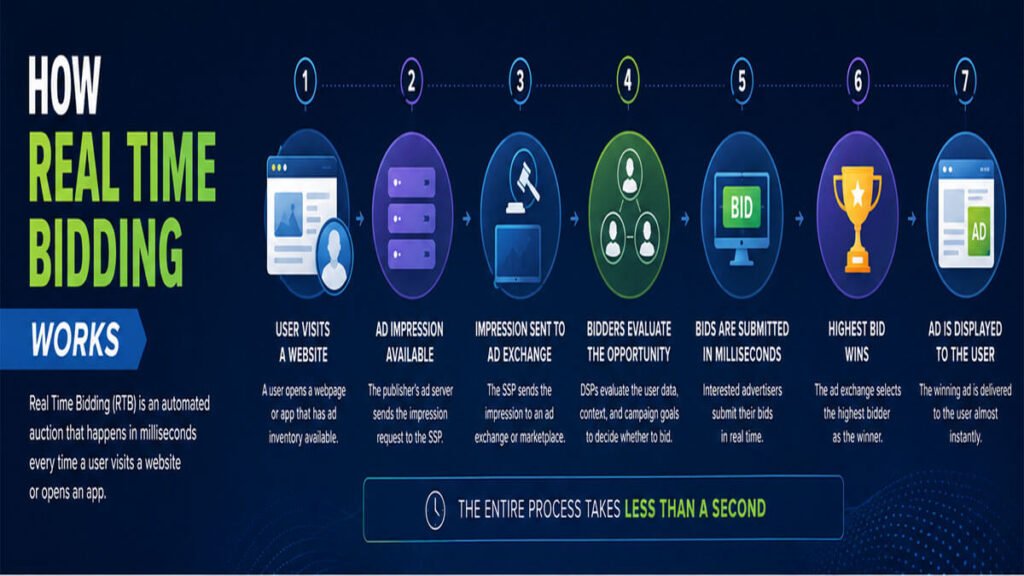
As soon as a user visits a web page, an available impression is put up for auctioning among advertisers. The value of the ad impression is judged by the advertiser who places the bid through automated systems.
The interesting thing about the whole process is its speed. Usually, the user does not even notice the difference since the auction takes place before the web page has been completely loaded.
That is precisely why What Is Real Time Bidding continues to be the most critical question for any business interested in programmatic advertising.
How Real Time Bidding Works
Many newcomers to programmatic advertising understand the concept but still ask How Real Time Bidding Works in practice.
Imagine a user visits a travel blog. The website has advertising space available. Instead of assigning that space to a pre-selected advertiser, the impression is offered to the marketplace.
Multiple advertisers instantly evaluate the opportunity.
One airline may recognize that the visitor recently searched for flights. A hotel chain may see signals suggesting an upcoming trip. A travel insurance company may identify the same visitor as a potential customer.
Each advertiser uses technology that evaluates impression value before bidding and then decides how much to bid.
This bidding is done within milliseconds, the winning bidder is selected, and his advertisement gets displayed.
This, in essence, is how real-time bidding works. It may sound like an elaborate procedure due to the number of technologies being used in the process, but the basic principle behind it is quite simple.
Why Advertisers Prefer Real Time Bidding Advertising
One reason Real Time Bidding Advertising has become so common is efficiency.
Not every website visitor has the same value to an advertiser. A person actively researching a product is usually more valuable than someone casually browsing unrelated content.
With traditional media buying, advertisers often paid for broad exposure. Real Time Bidding Advertising allows them to focus spending on impressions that are more likely to produce results.
That doesn’t guarantee success, of course. Good targeting and creative execution still matter. However, the ability to evaluate impressions individually gives advertisers far greater control over how budgets are spent.
Large brands, e-commerce companies, software providers, and local businesses all use Real Time Bidding Advertising in some form today.
The Technology Behind Real Time Bidding Platforms
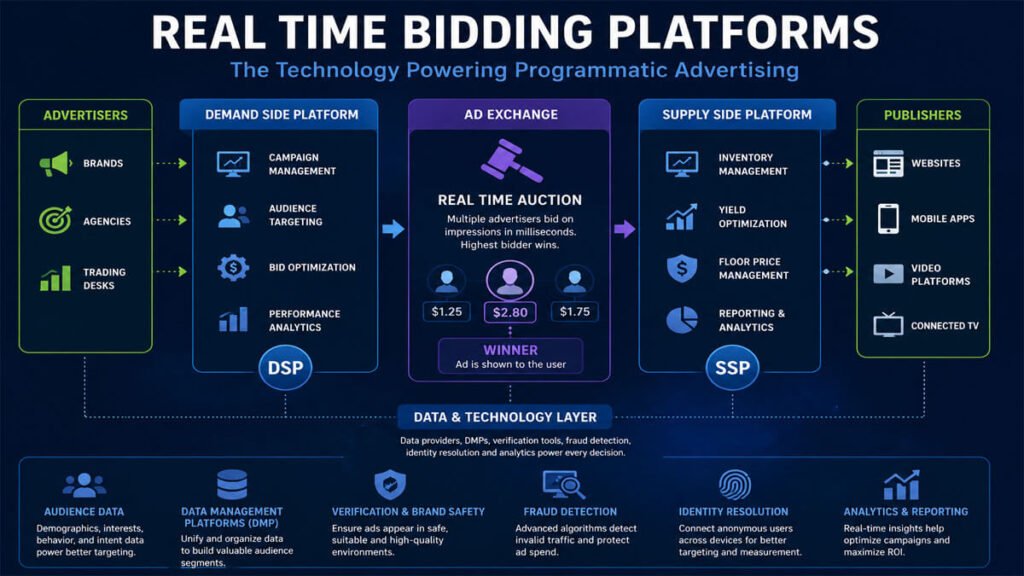
Behind every RTB auction is a network of technologies working together.
Ad networks often use demand-side platforms for campaign management and bidding. On the other side, publishers rely on revenue-focused inventory management technology to make available impressions accessible to buyers. In between is the auction marketplace that connects advertising buyers and sellers, where bidding takes place.
These Real Time Bidding Platforms are constantly exchanging information and processing decisions.
From the outside, the system looks simple. A webpage loads and an ad appears. Behind the scenes, however, numerous technologies are evaluating audiences, calculating bids, preventing fraud, and determining which advertisement should be displayed.
The scale is enormous. Some platforms process millions of auctions every second.
Understanding the Real Time Bidding Process
The Real Time Bidding Process is often described as an auction, but it is really a sequence of automated decisions.
A publisher offers an impression. Advertisers evaluate it. Bids are submitted. A winner is selected. The advertisement is delivered.
The uniqueness about the Real Time Bidding Process comes from the fact that this process goes through in cycles for every single impression.
It means that advertisers don’t have to buy their audience in bulk but can decide to go with each impression individually. An alternative approach involves reserving premium advertising inventory before a campaign even begins. That would create a situation where the value of an inventory would depend on supply and demand and advertiser objectives.
This would be positive for publishers as well as it would mean extra earnings from their impressions.
Conclusion
Real Time Bidding is now considered one of the main technologies that make up programmatic advertising. Unlike traditional media buying processes, this technology allows advertisers to analyze and buy individual impressions, making their efforts more relevant to their target audience and more efficient from a budget perspective.
The importance of understanding What is Real Time Bidding cannot be overstated since RTB is now at the heart of any advertising activity. All aspects of automated auctions, audience targeting, as well as DSP, SSP, and ad exchanges, make real-time bidding possible. Advertisers seeking greater control over inventory quality often complement RTB campaigns with private marketplace buying.
Considering the ongoing development of digital advertising, RTB seems to be one of the mechanisms that will be used more frequently as a means of connecting businesses with users. The knowledge of real-time bidding basics might help advertisers increase their efficiency by taking better advantage of the available advertising opportunities.
Businesses looking to improve campaign performance at scale often invest in specialized programmatic campaign management to gain deeper insights and optimize bidding strategies.
FAQs
What is the real time bidding system?
Real-Time Bidding is an automated bidding process whereby advertising slots on web pages and applications can be bid for immediately they become available. The auction takes place each time a user accesses a web page or application.
What is an example of real time bidding?
If a person lands on any sports website, before the page is loaded, several advertisers who are interested in reaching out to their audience would bid for the available ad space. The ad of the successful advertiser would then be displayed on the webpage.
What is RTB in simple terms?
RTB, or Real Time Bidding, is a technology that lets advertisers compete for ad space through automated auctions that take place in milliseconds.