
If you have even dabbled into the world of digital advertising, chances are you have heard about RTB, DSP, Ad Exchanges, and Private Marketplaces. Sitting in between all these buying solutions is Programmatic Direct—a solution which combines automation and control in order to help advertisers achieve optimal results with less hassle.
So what is Programmatic Direct?
In simple terms, Programmatic Direct is when an advertiser purchases ad inventory from the publisher using automation technology. However, as opposed to other types of technology, there is no auction process since everything is pre-negotiated.
Programmatic Direct is crucial in modern-day media buying for companies looking for high-quality placements and predictable campaign results.
What Is Programmatic Direct?
To understand what is Programmatic Direct, it helps to first understand the broader programmatic advertising ecosystem that powers automated media buying.
In a typical real-time bidding environment, advertisers compete against each other every time an ad impression becomes available. The highest bidder usually wins, and the ad is served instantly.
Programmatic Direct works differently.
Advertisers do not participate in an auction but rather buy inventory directly from publishers before launching their campaigns. During negotiations, agreements will be reached between both parties regarding price, format of ads, target audience criteria, among others. After everything is agreed upon, the advertiser’s campaign will run automatically using advertising technology platforms.
With Programmatic Direct, advertisers get access to premium inventory while reducing uncertainties in the buying process.
In light of the growing competition in digital marketing, it is no surprise why more brands are investigating Programmatic Direct and trying to incorporate it into their media planning.
Programmatic Direct Advertising
One of the many reasons why Programmatic Direct Advertising remains popular among advertisers is because they need more control over their campaigns.
Imagine a luxury car manufacturer launching a new model. Rather than hoping to win impressions through open auctions, the brand may want guaranteed placements on trusted automotive, business, or news websites. Programmatic Direct makes this possible.
With Programmatic Direct Advertising, advertisers know exactly where their ads will appear before the campaign starts. This differs from open ad exchange environments where inventory is typically bought through auctions and real-time competition. That level of certainty is difficult to achieve through open exchanges.
Publishers also benefit. Unlike the uncertain process of bidding on auctioned spaces, they can sell high-end inventories on set prices. The result? Higher revenue potential and better relationships between advertisers.
The second benefit of Programmatic Direct Advertising has something to do with brand safety. With inventory from trusted sources, advertisers are assured that there will be no inappropriate content for their ads.
This makes Programmatic Direct Advertising the go-to choice for campaigns that value reputation and visibility.
How Programmatic Direct Works
Many people understand the concept but still wonder exactly How Programmatic Direct Works in practice.
The process is actually quite straightforward.
The inventory that can be sold directly by the publisher needs to be determined first. It may consist of homepage placements, premium display inventory, video inventory, or other types of high-priced inventory for advertising.
Then the advertiser and the publisher talk about the parameters of the campaign. They agree on price, audience targeting, amount of inventory, and duration of the campaign.
After making a deal, it is implemented via advertising technologies platforms. The inventory is accessed through a demand-side platform used by advertisers to manage and execute programmatic campaigns, while publishers deliver ads through an SSP or ad server.
And here comes another difference between How Programmatic Direct Works and direct advertising. The negotiation may take place between both advertisers and publishers, but the process itself remains automated.
During the process, impressions are delivered automatically, and their statistics can be tracked.
When marketers ask How Programmatic Direct Works, the simplest answer is this: direct agreements combined with automated ad delivery.
Types of Programmatic Direct Deals
Programmatic Direct isn’t limited to a single transaction type. Several deal structures fall under this category.
Programmatic Guaranteed
In a Programmatic Guaranteed deal, both inventory and impression volume are guaranteed. The advertiser agrees to purchase a fixed amount of inventory at a predetermined rate.
Preferred Deals
Preferred Deals give advertisers the first opportunity to purchase inventory before it becomes available elsewhere.
Automated Guaranteed
This model combines guaranteed inventory with fully automated campaign management and reporting.
Each option provides different levels of flexibility, but all share the same goal: connecting advertisers and publishers through direct, technology-driven agreements.
Benefits of Programmatic Direct
There are plenty of reasons why advertisers continue to invest in Programmatic Direct.
The most obvious benefit is premium inventory access. Many high-quality publishers reserve their best placements for direct buyers rather than making them widely available through open auctions.
Transparency is another major advantage. Greater visibility into inventory sources also supports more efficient supply paths and stronger advertising performance. Advertisers know exactly where their ads are running and who they are buying from.
Predictable pricing also matters. In auction environments, costs can rise unexpectedly due to increased competition. Programmatic Direct eliminates much of that uncertainty by establishing pricing before the campaign begins.
Brand safety remains another important factor. For companies spending significant advertising budgets, controlling ad placement is often just as important as reaching the right audience.
These benefits explain why Programmatic Direct continues to attract both global brands and growing businesses.
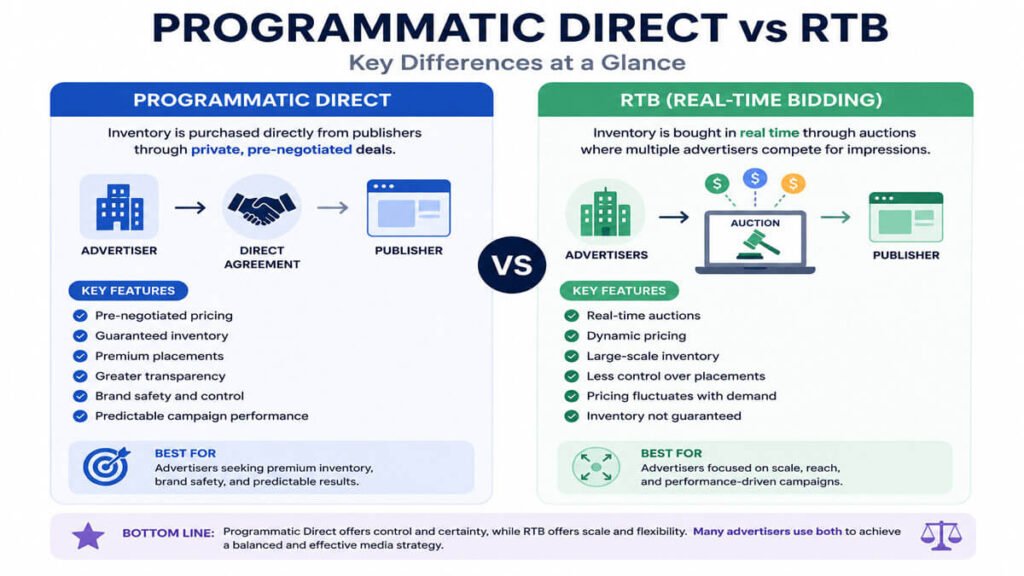
Programmatic Direct vs RTB
Comparison between Programmatic Direct vs RTB is always popular because these two strategies are commonly used by advertisers.
Despite similarities in technology, the mechanisms of purchases vary drastically.
Programmatic Direct involves purchase of media inventory according to a pre-agreed schedule. The price and quantity of available inventory are established before the campaign starts.
On the contrary, RTB relies on a real-time auction model where advertisers compete for individual impressions as they become available. In such a case, the advertiser has no way of predicting the exact price.
The choice between Programmatic Direct vs RTB depends on the marketing goals.
Campaigns that aim at achieving maximum scale tend to use RTB, while those targeting premium placements usually favor Programmatic Direct.
However, in reality, brands tend to utilize both options.
In reality, many advertisers use both approaches together rather than choosing one exclusively.
Programmatic Direct vs Private Marketplace
Another common comparison is Programmatic Direct vs Private Marketplace.
At first glance, the two can appear similar because both involve premium inventory and restricted advertiser access.
The difference lies in how inventory is purchased.
This is attributed to the manner in which inventory is bought.
In Programmatic Direct, inventory is acquired by way of an arrangement made between the advertiser and the publisher. There is advance negotiation of pricing and, at times, guarantees on the inventory.
In case of Private Marketplace, the advertisers are invited to take part in auctions. Understanding how private marketplace auctions work can help advertisers decide whether a PMP or a direct buying arrangement is the better fit for their campaigns. Even though their participation is limited, winning is still based on bids.
On comparing Programmatic Direct vs Private Marketplace, advertisers need to decide on whether guaranteed access is more important than the flexibility in a bid process.
Final Thoughts
It is therefore essential to have knowledge about Programmatic Direct since this can provide more transparency and control when it comes to advertisers’ media investments.
Although auction-based media buying will continue being significant in the programmatic world, Programmatic Direct gives one certainty that is often desired by some brands. This is because advertisers know exactly where their ads will run, and the publishers are aware that certain inventory is sold; they both enjoy automation as well.
With the development of the programmatic market, the importance of Programmatic Direct will increase significantly for various brands as well. Many businesses work with specialized programmatic advertising experts to build direct buying strategies and improve campaign performance at scale.
FAQs
What is Programmatic Direct?
Programmatic Direct is the purchase of digital advertising inventory directly through publishers via automation, as opposed to doing it in real time.
How Does Programmatic Direct Work?
There will be a pre-negotiation process that will define the cost, terms of service, target audience, among other elements of interest for both parties. Once that is agreed upon, then technology handles the delivery and reporting process.
What Is The Difference Between Programmatic Direct And RTB?
The main difference between Programmatic Direct and RTB is that the former relies on pre-agreements while the latter operates through live bidding auctions.
What Is The Difference Between Programmatic Direct and Private Marketplace?
Programmatic Direct is done through a direct arrangement between advertiser and publisher, whereas Private Marketplaces operate through invitation-only auctions.