
What is Programmatic Advertising?
What is programmatic advertising? This term might sound familiar to those involved in the industry of digital marketing, advertising, media buying, and even content publishing. In fact, it’s quite likely that you have heard of it more often than actually comprehending its definition.
Well, the answer is easy. Nowadays, the majority of ads seen by Internet users are served through programmatic advertising. Be it web, video, app, or connected TV, it is possible that the ads shown were delivered using programmatic advertising techniques.
Back in the day, the system of digital ads was completely different. Advertisers used to reach out to the owner of a website where they would run ads, discuss terms of cooperation, negotiate deals, and handle their campaigns manually. However, with time, such a practice became impossible for several reasons.
This is exactly where programmatic advertising changed the game.
Instead of people handling everything manually, software now automates most of the process. Ads can now be bought, sold, and displayed almost instantly through automated advertising systems.
Programmatic Advertising Definition
Let’s start with a simple programmatic advertising definition.
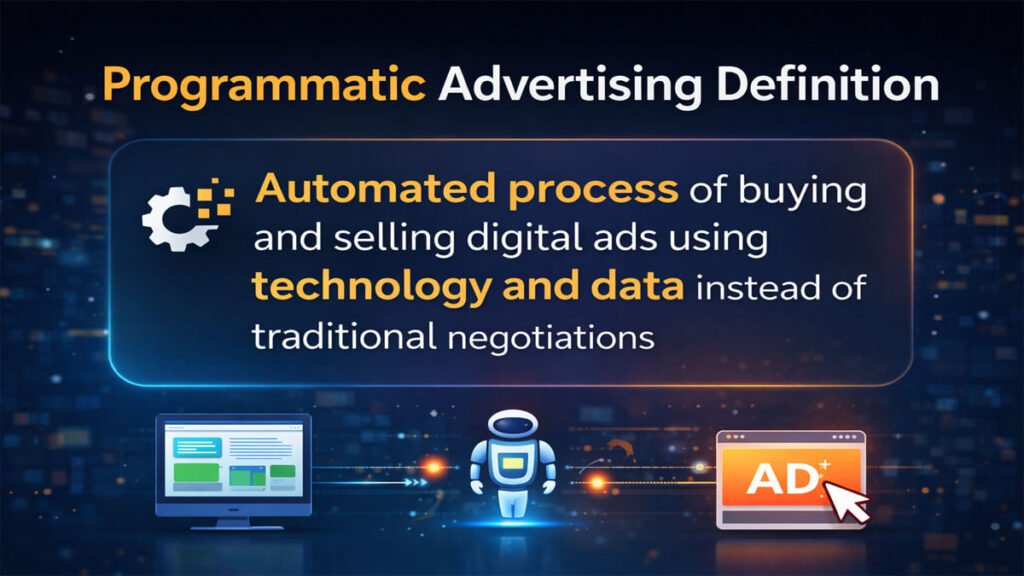
Programmatic advertising is the automated process of buying and selling digital advertisements using technology, software, and real-time data.
That’s really the core idea behind it.
Instead of advertisers manually choosing every website or placement, advertising platforms now use algorithms and automated systems to decide where ads should appear and which audiences should see them.
Modern programmatic advertising systems can:
- Analyze user behavior
- Evaluate advertising opportunities
- Compare bids from advertisers
- Optimize campaigns automatically
- Display ads within milliseconds
All of this happens in the background while a webpage or app is loading.
Another important thing to understand about the programmatic advertising definition is that it isn’t just one tool or one platform. It’s actually a full advertising ecosystem made up of different technologies working together.
Some of the main parts of this ecosystem include:
- Demand-side platforms (DSPs)
- Supply-side platforms (SSPs)
- Ad exchanges
- Audience data platforms
- Real-time bidding systems
Communication between such systems is continuous as a way to automate digital advertising on websites, applications, video sites, streaming sites, and various other forms of digital media.
What Is Programmatic Advertising In Simple Words
And if all that seems too technical, then we can simplify.
Now imagine visiting a site and being immediately presented with an advertisement that is targeted at something you have been looking up recently. That is not simply a case of luck. In the background, the ad system has rapidly evaluated the signals from the audience, identified who among the advertisers would want to reach users similar to you, made comparisons, and chose the winner.
That entire process happened automatically.
So, what is programmatic advertising in simple words? It’s basically an automated way of deciding which ad should be shown to which person online.
Another easy way to think about it is like a super-fast programmatic ad auction process happening every time someone opens a webpage.
Here’s a simplified version of the process:
- A webpage loads
- Ad space becomes available
- Advertisers place bids automatically
- The system compares those bids
- The winning ad gets displayed
This is all done within a fraction of a second.
Even though the technology used in programmatic advertising may be sophisticated, the fundamental concept behind the technology is rather straightforward – improving digital advertisements through efficiency.
How Programmatic Advertising Works
It’s now time to take a closer look at how programmatic advertising operates.
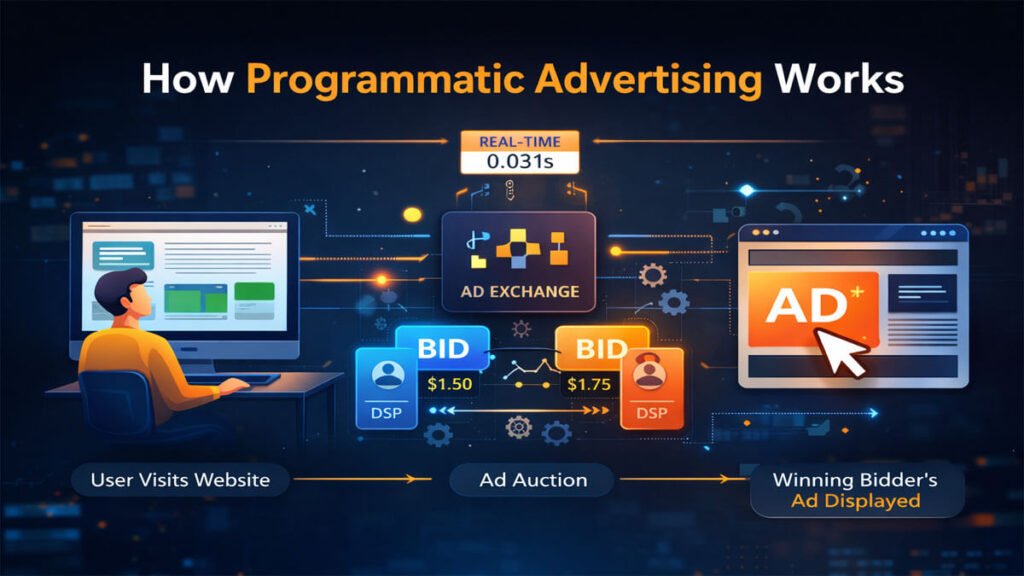
Programmatic advertising starts with a user visiting a site or an application which features advertisements. This information may include things like:
Device type
- Browser information
- Content category
- Audience signals
- Location data
- Available ad format
Advertisers connected to the ad exchange then decide whether they want to bid for that advertising opportunity.
If the audience matches their targeting preferences, automated bids are submitted through demand-side platforms, also called DSPs.
Multiple advertisers can bid at the same time. The system then compares those bids and selects the winner automatically. In many modern advertising setups, header bidding is also used to increase auction competition before the final advertisement gets selected.
The winning advertisement is displayed almost instantly. If you want to explore the auction flow in more detail, this guide explains how programmatic advertising works step by step from ad request to final ad delivery.
That’s the basic process behind how programmatic advertising works.
There are also several technologies involved behind the scenes.
Demand-Side Platforms (DSPs)
DSPs help advertisers buy digital ads automatically across multiple websites and advertising networks.
Supply-Side Platforms (SSPs)
SSPs help manage advertising inventory and connect available ad placements with advertising demand.
Ad Exchanges
Ad exchanges are digital marketplaces where advertisers and advertising platforms compete in real-time auctions. To better understand how these marketplaces operate and facilitate automated ad buying, explore our guide on how ad exchanges connect advertisers and publishers.
Modern programmatic advertising systems also use:
- Machine learning
- Audience segmentation
- Contextual targeting
- Behavioral analysis
- Campaign optimization algorithms
These systems assist advertisers to enhance their targeting and perform better.
Programmatic Advertising Examples
Real-life examples can make the concept of programmatic advertising clearer.
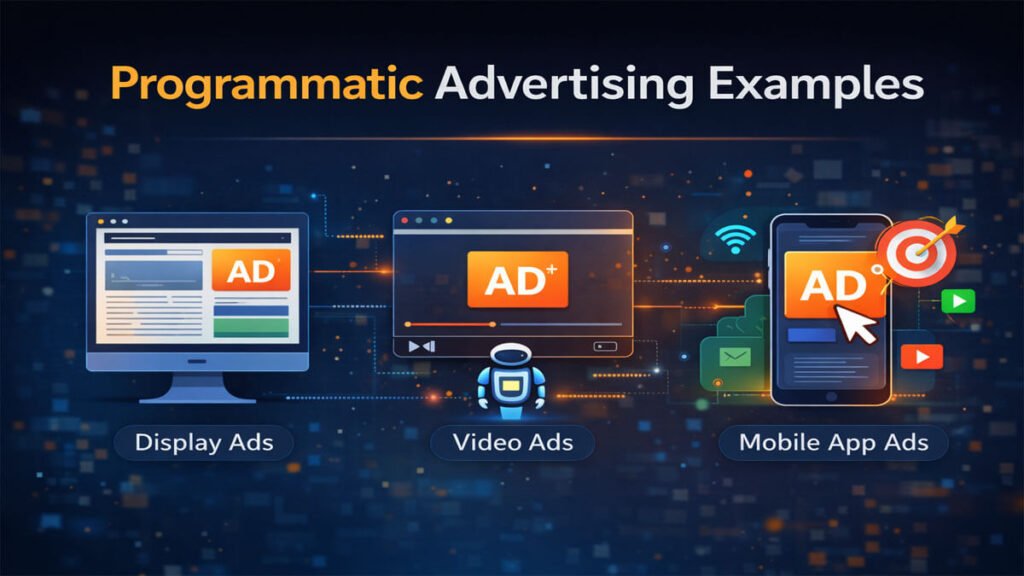
A typical example of programmatic advertising involves display advertising on websites. When browsing an online magazine, a news site, sports site, or any other blog or website, you may find ads that have been selected using programmatic advertising.
Video advertising is another example. Ads shown before or during online videos are frequently delivered through automated advertising systems using real-time bidding technology.
Mobile apps also use programmatic advertising heavily. Many apps display ads based on user behavior, interests, app activity, and browsing patterns.
Connected TV advertising has become another major area. Streaming platforms now use automated systems to deliver targeted advertisements during digital TV content.
Other common programmatic advertising examples include:
- Native advertising
- In-app advertising
- Digital audio ads
- Gaming advertisements
- Retail media ads
- Digital billboard advertising
These examples show how programmatic advertising now operates across many different digital environments, not just traditional website banners.
As digital advertising continues growing, businesses increasingly use programmatic advertising to improve:
- Audience targeting
- Advertising efficiency
- Campaign scalability
- Media buying automation
- Performance optimization
Why Programmatic Advertising Matters Today
The reason programmatic advertising matters so much today is because digital advertising has become incredibly large and complex.
Advertisers now run campaigns across:
- Websites
- Mobile apps
- Streaming services
- Connected TV
- Online video
- Gaming platforms
- Digital audio channels
Trying to manage all of this manually would take enormous amounts of time and effort.
Programmatic advertising helps simplify that complexity through automation.
One of the biggest advantages is speed. Advertisers can launch campaigns quickly, adjust targeting in real time, optimize budgets automatically, and scale campaigns across thousands of placements at once.
Another major advantage is audience targeting.
Modern advertising systems can analyze:
- User interests
- Browsing behavior
- Demographics
- Engagement patterns
- Contextual signals
This helps advertisers show more relevant ads to more relevant audiences.
Because of this, programmatic advertising has become one of the main technologies driving the future of digital advertising and online media buying.
Conclusion
What, then, is programmatic advertising?
To put it briefly, it’s a way of purchasing and selling digital advertisements through software, algorithms, and real-time data.
Once you’ve learned what programmatic advertising is, what is programmatic advertising in simple terms, how programmatic advertising works, and seen some examples of programmatic advertising, you’ll find that the general idea is quite clear.
Programmatic advertising has revolutionized the landscape of digital advertising, enabling a fast, automatic, and data-driven process of delivering campaigns.
As advertising on the internet is developing, programmatic advertising will certainly remain one of its key aspects.
FAQs
What is programmatic advertising in simple terms?
Programmatic advertising is an automated method of buying and selling digital advertisements using software and real-time data instead of manual advertising negotiations.
What are the 4 types of programmatic deals?
The four major types of programmatic advertising deals are:
- Real-time bidding (RTB)
- Private marketplace (PMP)
- Preferred deals
- Programmatic guaranteed
Is Google Ads programmatic ads?
Though Google Ads in its entirety is not completely classified as programmatic advertising, certain systems in Google Display & Video 360 and Google Ad Manager can be considered to belong to the domain of programmatic advertising.
What are the 4 types of advertising?
The four common types of digital advertising include:
- Display advertising
- Video advertising
- Native advertising
- Programmatic advertising